
Request Information
Ready to find out what MSU Denver can do for you? We’ve got you covered.
By Kathryn Williams, Instructional Accessibility Specialist, 8 August 2025

People with disabilities have existed throughout history, but disability rights and accessibility are relatively modern with the Social Security Act of 1935 being the first federal program for people with disabilities.
Even in 2025, people with disabilities continue to fight for their civil rights and equitable access. In education and in life, students, faculty, and staff might encounter physical access barriers (such as doorframes that cannot accommodate a walker), digital access barriers (such as documents which are not compatible with screen readers), or inequitable access (such as an elevator requiring a special call and a wait for someone with a key).
While the last 100 years have brought some rapid change, there is still much to do to as we strive to create inclusive and accessible spaces by identifying and removing barriers.

Some ancient civilizations considered people with disabilities to be inferior, unclean, or disfavored by deities, leading to ostracism or even euthanasia. Even as some attitudes changed with time, people with disabilities were still not considered equal humans and were considered to exist for non-disabled people to provide service. Royal courts kept people with disabilities as the court “fool” or “jester” to provide entertainment for nobles.

Born in Pueblo, Joe Arridy was wrongfully arrested as a suspect in a murder case and executed in 1939. Arridy had cognitive disabilities and was estimated to have the cognitive ability of a child around 6 years old, but seemed to be in the wrong place at the wrong time to be arrested and coerced into a false confession. Although the police had another suspect in custody with supporting evidence, the Wyoming sheriff in charge of Arridy’s arrest lead him to a false confession. This resulted in Arridy’s imprisonment and eventual execution, although attorney Gail Ireland had managed ten delays of execution. Arridy’s last meal was ice cream, and the priest who delivered last rites had to guide Arridy through the prayer two words at a time because Arridy couldn’t remember more than two words.
Coercion and false confessions remain a risk for defendants with disabilities.
In 2011, advocate work finally lead to a posthumous pardon for Arridy by Colorado Governor Bill Ritter.
Founded in Denver by Reverend Wade Blank with the goal of allowing every disabled individual, regardless of the extent of their disability, the same rights and responsibilities of their non-disabled peers, including the freedom to choose a lifestyle and fulfill personal goals in education, employment, and personal growth. Atlantis sought to facilitate freedom from nursing homes and from being segregated from the non-disabled “mainstream” society.
The people who became known as the Denver Gang of 19 were disability advocates who used mobility aids such as wheelchairs. In July 1978, the Gang of 19 protested RTD’s inaccessible city busses by blocking traffic for two days, citing “taxation without transportation” and the high-cost and difficulty of scheduling accessible public transportation. The Gang of 19 lead to Denver becoming one of the first major cities to provide accessible public transit with a third of the bus fleet to include wheelchair lifts.
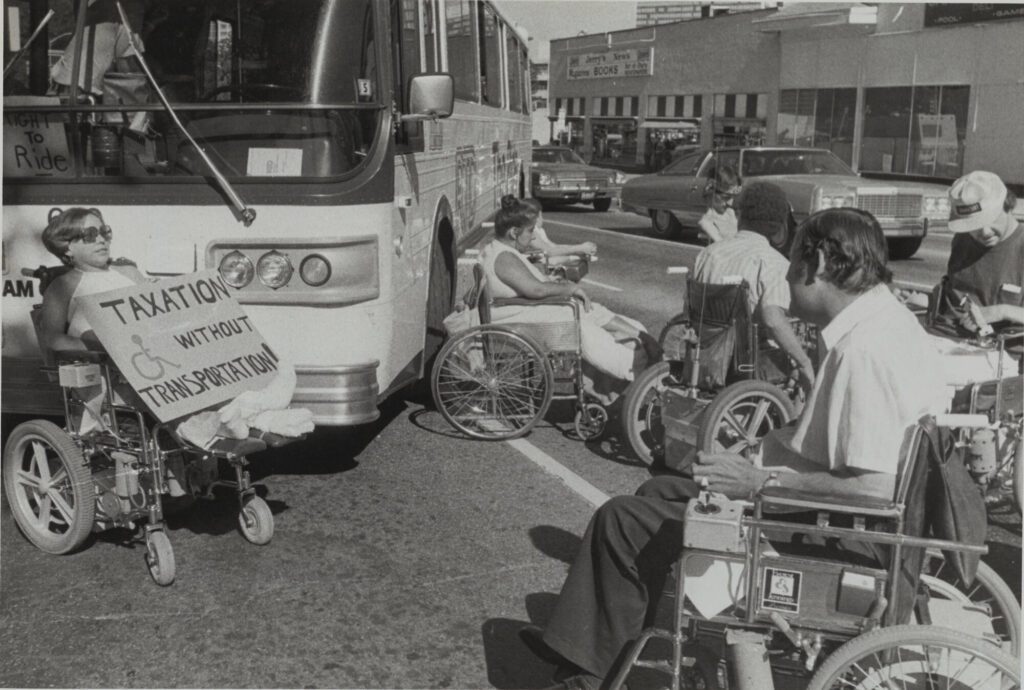
The Gang of 19 starts the American Disabled for Attendant Programs Today (ADAPT) (formerly Americans Disabled for Accessible Public Transit). ADAPT uses tactics similar to the Gang of 19 protest around the country at both city transit and interstate services like Greyhound. ADAPT’s work was instrumental in the development and enactment of the ADA in 1990. ADAPT continues to protest and fight for disability rights.
CO House Bill 21-1110 prohibits discrimination on the basis of disability, specifically with regards to government information technology. As a state university, MSU Denver falls under HB 21-1110, and the institution is actively working towards inclusive digital spaces.
While the wording of HB 21-1110 might sound intimidating, the CO Office of Information Technology website notes that public entities should focus on progress, not perfection, meaning that OIT recognizes the huge task of creating inclusive digital space. “However, they must show they are making progress toward accessibility and make it easy for people with disabilities to request assistance.” For faculty, this means being proactive while creating new materials by following accessible best practices, and remediating older material still in use as time allows.
The Instructional Accessibility Group encourages faculty to focus on inclusion, not compliance, meaning that if faculty approach course material creation with inclusion and accessibility in mind, they will be in compliance with the law. Here are some ways faculty can approach accessibility from an inclusion perspective:
A quote by disability advocate MisaOnWheels illustrates the importance of proactive accessibility: “When accessibility is an afterthought, the message becomes ‘We tolerate you’ rather than ‘We welcome you.'”
The IAG provides accessibility guides here on our webpages and offers our 30-minute Accessibility Bytes live virtual trainings throughout the fall and spring semesters to support faculty on their quest towards accessible courses.