What is GAAD?

Global Accessibility Awareness Day grew from an idea in 2011 from a blog post by web developer Joe Devon, which was then amplified by accessibility professional Jennison Asuncion. Currently, GAAD has sparked both in-person and virtual events around the world to promote accessibility.

logo GAAD full text
In 2023, the World Health Organization estimated that around 1.3 billion people live with a significant disability, or about 16% of the world population. MSU Denver’s 2026 fact sheet counts 18,336 students, so 16% of that number would be around 2,900 students that can benefit from faculty, staff, and campus planners making proactive accessibility a priority. In addition to those who identify as having a disability, there are still others who are either undiagnosed or do not wish to disclose their disability.

21 May 2026 is the 15th GAAD and the IAG encourages our MSU Denver community to attend one of the convenient virtual events to learn more about accessibility endeavors around the world.

GAAD 2026 Events

Events (times are in MST):

  • Accessible does not equal Equitable: Real Human Experience vs Compliance. 19 May 2026 (two days early!), 4p-5p. Virtual. TTC Global, Australia.
    We’ve been told that accessibility is a checklist. Meet the criteria. Pass the audit. Ship the product. But real users tell a different story. In this webinar to celebrate Global Accessibility Awareness Day (GAAD), we explore the uncomfortable truth that a product can be fully compliant and still fail the people it’s meant to support. Drawing on real user experiences, we’ll expose the hidden friction that standards don’t capture , from cognitive overload to interaction fatigue and loss of confidence. This isn’t about dismissing accessibility standards. It’s about recognising their limits. Because if people can technically use your product, but can’t use it easily, safely, or with dignity, is it truly accessible. Learning outcomes: Recognise the limitations of compliance as a measure of accessibility Understand how friction manifests for people with disability and other marginalised groups Explore a more human-centred approach to accessibility grounded in real experience.
  • GAAD 2026 Design, Develop, Deliver. 21 May 2026, 8:30a-1:45p. Virtual. University of Minnesota, University of Illinois System, University of Michigan.
    GAAD 2026 will include a keynote presentation from Dr. Shanna Kattari titled “At the Intersection of Access and Justice” and several breakout sessions in the areas of building accessible digital experiences, accessible content & communication, and advancing accessibility practices.
  • Level Up: Creating an Experiential Accessibility Lab. 21 May 2026, 1p-2p. Virtual. Workday.
    How do you move beyond theory and really help people “get” accessibility? In this special Global Accessibility Awareness Day (GAAD) session of Workday’s Accessibility Level Up series, Joe Rogers and Greg Aikens share how Workday built an experiential accessibility lab from the ground up and how you can adapt these ideas within your own organization. We’ll cover what an accessibility lab is (and what it is not), lessons learned from Workday’s lab journey, and examples of how other companies like Accenture, Microsoft, and Google have approached similar spaces. You’ll come away with practical considerations, pitfalls to avoid, and ideas for using labs to drive lasting culture change, deeper empathy, and better digital products for people with disabilities.
  • Webinar on Accessible Communication Campaigns. 21 May 2026, 3a-8a. Virtual. FightTheStroke Foundation and Cerebral Palsy Europe.
    Planned inside the ‘Voice for All’ European project, the webinar will train participants in how to design and implement different kinds of accessible communication campaigns that contribute to the democratic process, including the relevance of different media for reaching specific target groups and the importance of tailoring language to the audience. Promoted by Cerebral Palsy Europe, curated by Fightthestroke Foundation.

Continue the work

Expand your accessibility work by working to build a culture of accessibility at MSU Denver. No matter where you are in your accessibility journey, it’s always a great time to take another step.
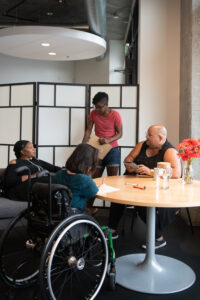
Four disabled people of color gather around a table during a meeting. A Black woman sitting on a couch speaks with a neutral expression while the three others (a South Asian person sitting in a wheelchair and taking notes, a Black non-binary person sitting in a chair with a tablet and cane, and a Black non-binary person standing with a clipboard) listen.
Image credit: Disabled And Here