
Request Information
Ready to find out what MSU Denver can do for you? We’ve got you covered.
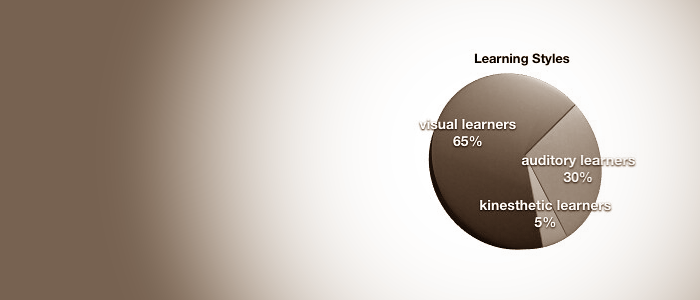
Chances are you’ve heard of “learning styles” in one form or another, maybe even the most famous (or infamous) version where each person is either a Visual, Auditory or Kinesthetic learner (VAK). But beware! VAK is a myth, as are the many, many other types of learning styles!
As early as the 1950s, educators proposed versions of the core idea of learning styles:
There are different types of learners, falling into just a few types. This “learning style” is a stable feature of the learner. And, crucially, if a learner is taught in a way that matches their type, their learning will improve.
This idea didn’t originate from careful study of how people learn. Rather, it seems to be an overextension of theories developed to address remedial learning, particularly for people with learning disabilities. Regardless of the origin, validity and applicability, the core idea of learning styles took off and became a widespread concept.(1)
By the 1990s, online learning style diagnostics were available for free, and many instructors adopted the whole idea as a way to improve student learning. It is an incredibly widespread idea, with a large majority of college professors and secondary teachers reporting that they have heard of it and believe it is real.(1)
And yet, from the very start, the evidence has been weak or absent. For many teachers it sounds plausible, and it may feel like it offers a tool to improve our students’ learning. And as often happens, a robust industry has grown to sell and support this myth to districts, students, teachers, and parents. But robust research, over the span of several decades, has shown that so-called learning styles are neither stable nor reliable. Even worse, matching teaching methods to learning styles has no impact on learning in children or adults.
Learning styles don’t exist. So, what now? The fact that learning styles don’t exist doesn’t mean everyone is the same, and it doesn’t mean that all types of teaching are equal. So, when we set aside learning styles, one framework to reach for might be Universal Design for Learning (UDL).(3)
UDL has three core concepts that are well-supported by research. In addition, they explicitly align with accessibility requirements that all MSU Denver faculty should strive to meet.
There is a wealth of excellent information about how UDL can apply to your teaching, including from the Instructional Accessibility Group in the CTLD. Try some other approaches and help put the myth of learning styles to rest.
 Generative AI disclosure: After writing this piece I used generative AI to write a first draft of the short “teaser blurb” that went out by email. ” Want to know more? Send me an email and we can chat!