
Request Information
Ready to find out what MSU Denver can do for you? We’ve got you covered.

Are you eager to discuss new and thought-provoking books about teaching? Do you have a pile of books you haven’t yet had the time to read?
The CTLD offers both book discussions (informal discussion group will explore a different book at each meeting) and book clubs (a small group reading and discussing a book together over a semester).
During the Spring 2026 semester, we will be hosting a Book Club FLC.
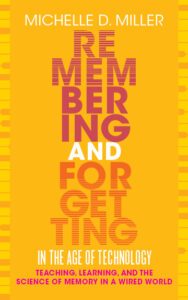
Participants in this Book Club FLC will read the book, Remembering and Forgetting in the Age of Technology. As we read each chapter over the semester, we will apply concepts from the book to our own courses and discuss strategies and challenges.
Bonus: the author will be visiting campus in February as part of the CTLD-hosted T4L Conference!
Remembering and Forgetting in the Age of Technology: Teaching, Learning, and the Science of Memory in a Wired World (West Virginia University Press, 2022), is written by Michelle D. Miller, This book takes a deep dive into how memory works—and what that means for how we teach. In an era of instant information and generative AI, how can technology help as well as hinder our ability to remember? Drawing on both classic research and current findings, this book offers practical strategies for helping students build meaningful, lasting knowledge while navigating a digital world.
FLC Meeting Dates and Times
The FLC will meet 5 times during the spring semester and active participants receive a copy of the book.
Meetings will be on Mondays, 2:00-3:00 pm, virtually via Teams.
Meeting dates: Feb 2, Feb 23, March 16, April 6, and April 27.
If you are interested in joining, please fill out this form.
For questions, contact:
Bridget Arend at [email protected]
Fall 2025
Participants in this Book Club FLC will read the book, Small Teaching Online together as they apply concepts from the book to their own courses and discuss strategies and challenges.
Small Teaching Online, by Flower Darby and James Lang, builds from James Lang’s popular book Small Teaching in the Classroom. The concept of small teaching is that certain small and strategic changes have enormous power to improve student learning. Instructors face unique and specific challenges when teaching an online course. This book offers practical and feasible applications of theoretical principles to help online students learn. It includes current best practices around educational technologies, strategies to build community and collaboration, and small but impactful adjustments that can result in significant learning gains.
Contact Bridget Arend for an overview of notes and takeaways from the group discussions.
In this book discussion we pulled ideas from three different texts about “rest.”
Sacred Rest, by Saundra Dalton-Smith
Dr. Saundra Dalton-Smith, a board-certified internal medicine doctor, shares seven types of rest found lacking in the lives of those she encounters in her clinical practice and research–physical, mental, spiritual, emotional, sensory, social, creative–and why a deficiency in any one of these types of rest can have unfavorable effects on your health, happiness, relationships, creativity, and productivity.
View Dr. Dalton-Smith’s 10-minute TED Talk
Permission to Rest, by Ashley Neese
Wellness expert Ashley Neese combines personal essays, contemplative questions, scientific research, and somatic practices to help us disrupt the state of urgency. Neese presents a series of body-focused rest practices for those who are running on empty, addresses common roadblocks when beginning a rest practice, and a number of holistic resources for developing a sustainable relationship to rest, especially useful for those short on time.
Tricia Hersey, aka the Nap Bishop, casts an illuminating light on our troubled relationship with rest and how to imagine and dream our way to a future where rest is exalted. Our worth does not reside in how much we produce. Rest, in its simplest form, becomes an act of resistance and a reclaiming of power because it asserts our most basic humanity. We are enough.
Interview with Elizabeth Gilbert
By Rebecca Glazier
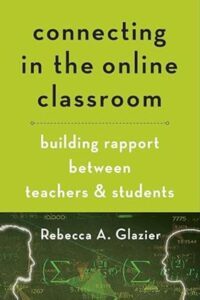
Book description: More students than ever before are taking online classes, yet higher education is facing an online retention crisis; students are failing and dropping out of online classes at dramatically higher rates than face-to-face classes. Grounded in academic research, original surveys, and experimental studies, Connecting in the Online Classroom demonstrates how connecting with students in online classes through even simple rapport-building efforts can significantly improve retention rates and help students succeed.
Drawing on more than a dozen years of experience teaching and researching online, Rebecca Glazier provides practical, easy-to-use techniques that online instructors can implement right away to begin building rapport with their students. She also presents case studies of universities that are already using these strategies, along with specific, data-driven recommendations for administrators, making the book valuable for faculty, instructional designers, support staff, and administrators alike.
The science-backed strategies that Glazier provides will enable instructors to connect with their students and help those students thrive. Speaking to the paradox of online learning, the book also explains that, although the great promise of online education is expanded access and greater equity―especially for traditionally underserved and hard-to-reach populations, like lower-income students, working parents, first-generation students, and students of color―the current gap between online and face-to-face retention means universities are falling far short of this promise.
Read a summary of the discussion and strategies discussed.
Or view this 24-min interview from The Teaching Curve Podcast.
By Jose Antonio Bowen and C. Edward Watson
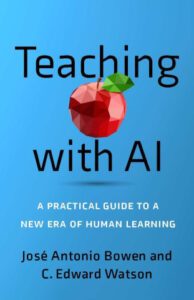
Book description: Artificial Intelligence (AI) is revolutionizing the way we learn, work, and think. Its integration into classrooms and workplaces is already underway, impacting and challenging ideas about creativity, authorship, and education. In this book, the authors explore how to harness and manage AI as a powerful teaching tool.
From interactive learning techniques to advanced assignment and assessment strategies, this comprehensive guide offers practical suggestions for integrating AI effectively into teaching and learning environments. Bowen and Watson tackle crucial questions related to academic integrity, cheating, and other emerging issues.
In the age of AI, critical thinking skills, information literacy, and a liberal arts education are more important than ever. As AI continues to reshape the nature of work and human thinking, educators can equip students with the skills they need to thrive in a rapidly evolving world. This book serves as a compass, guiding educators through the uncharted territory of AI-powered education and the future of teaching and learning.
By Dr. Gina Ann Garcia
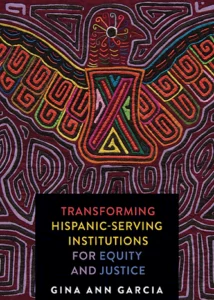
Beyond having over a quarter of their undergraduate students Hispanic, what makes Hispanic-Serving Institutions (HSIs) uniquely Latinx? And how can university leaders, faculty, and staff transform these institutions into spaces that promote racial equity, social justice, and collective liberation? In this book, Dr. Garcia argues that in order to serve Latinx students and other students of color, these institutions must acknowledge how whiteness operates across the organization, from the ways that it is governed and how decisions are made to how education and knowledge are delivered. Diversity alone is insufficient for achieving a dynamic learning environment within higher education institutions. In Transforming Hispanic-Serving Institutions for Equity and Justice, Garcia offers a framework for transforming HSIs into truly Latinx-serving. The framework is grounded in critical theories, yet it advances new ways of thinking about how to organize colleges and universities that are actively serving students of color, low income students, and students from other minoritized backgrounds. This framework connects multiple important dimensions, including mission, identity, strategic purpose, membership, curriculum, student services, physical infrastructure, governance, leadership, external partnerships, and external influences. Drawing on over 25 years of HSI research, Garcia offers unique solutions for colleges and universities that want to better serve their students.
Ungrading: Why Rating Students Undermines Learning (and What to Do Instead)
Edited by Susan Blum
Discussion facilitated by Karen Marie Jaramillo, Chicana/Chicano Studies, and Bridget Arend, CTLD
In Ungrading, fifteen educators write about their diverse experiences going gradeless. Some contributors are new to the practice and some have been engaging in it for decades. Some are in humanities and social sciences, some in STEM fields. Some are in higher education, but some are the K–12 pioneers who led the way. Based on rigorous and replicated research, this is the first book to show why and how faculty who wish to focus on learning, rather than sorting or judging, might proceed. It includes honest reflection on what makes ungrading challenging, and testimonials about what makes it transformative.
Unraveling Faculty Burnout: Pathways to Reckoning and Renewal, by Rebecca Pope-Ruark
Burnout, a mental health syndrome caused by chronic stress, is endemic to higher education and can unfortunately be seen as a badge of honor in a productivity-obsessed culture. This unique book blends memoir, key research, and reflection opportunities to help not only personally address burnout, but also explore, address and find strategies to mitigate burnout.
Pope-Ruark lays out four pillars of burnout resilience for faculty members: purpose, compassion, connection, and balance. In our discussion, we will explore some of the factors that contribute to burnout and discuss productive strategies for developing balanced, meaningful workplace cultures.
Alternatively, listen to a 30-min podcast interview with the author
Creating an LGBT+ Inclusive University: A Practical Resource Guide for Faculty and Administrators, by Kryss Shane
Book Description: The rates of bullying and dropouts due to lack of safety in colleges and universities and subsequent suicidality for LGBT+ young adults and college students are exponentially higher than for non-LGBT+ people. As a result, many American college students are suffering needlessly, and many faculty and administrators are unsure of what to do. Setting out best practices and professional guidance for creating LGBT+ inclusive learning in schools, this approachable and easy-to-follow book guides faculty, administrators, and other staff toward appropriate and proven ways to create safer learning environments, update campus policies, enhance curricula, and better support LGBT+ college students as they learn.
Author Dr. Kryss Shane is a clinical social worker and affiliate faculty member in MSU Denver’s Department of Social Work. Kryss is the author of numerous books, speaks worldwide on inclusion, and is a cast member on TLC’s “I Am Jazz” and joined us for this discussion.
Antiracism and Universal Design for Learning: Building Expressways to Success, by Andratesha Fritzgerald
In Antiracism and Universal Design for Learning: Building Expressways to Success, Andratesha Fritzgerald explores Universal Design for Learning (UDL) as an effective framework to teach Black and Brown students. Fritzgerald shares vivid portraits of classroom instruction and strategies for teaching. We will use this framework to discuss and brainstorm communication, engagement, and skill-building teaching strategies and methods for our own classrooms.
View a summary of the book
The Art of Gathering, Priya Parker
Do we rely too much on routine and on the conventions of gatherings? At a time when coming together is more important than ever, Priya Parker sets forth a human-centered approach to gathering that is aimed to help us create meaningful, memorable experiences. This book takes us inside events of all kinds to show what works and what doesn’t, and to explore how simple, specific changes can invigorate any group experience. Our discussion will center around what we can apply to the college classroom!
Grading for Equity, Jon Feldman
Read a SIP written about this book discussion!
Grading for Equity challenges nearly all our assumptions about assigning grades. As the cover states, this book tackles, “one of the most challenging and emotionally charged conversations in today’s schools: our inconsistent grading practices and the ways they can inadvertently perpetuate the achievement and opportunity gaps among our students.” Although written from a K-12 perspective, the book provides challenging ideas about issues such as the impact of grades on motivation, common but mathematically inaccurate practices, arguments against grading participation or practice work, and requiring retakes/revisions, among others.
Distracted: Why Students Can’t Focus and What You Can Do About It, James Lang
Why is it so hard to get students to pay attention? Conventional wisdom blames phones and personal devices, insisting that access to technology has ruined students’ ability to focus. James Lang argues that this solution obscures a deeper problem: how we teach is often at odds with how students learn. Classrooms are designed to force students into long periods of intense focus, but emerging science reveals that the brain is wired for distraction. We learn best when able to actively seek and synthesize new information. In Distracted, Lang shares ideas about how educators can structure their classrooms less as distraction-free zones and more as environments where they can actively cultivate their students’ attention.
Listen to a 10-minute podcast summary of the book.
These discussions are intended to create save/brave spaces for thought-provoking discussions. To that end, the following guidelines are suggested.
Thriving in Academia: Building a Career at a Teaching-Focused Institution, by Pamela Ansburg, Mark Basham, and Regan Gurung
Understanding by Design meets Neuroscience, Jay McTighe & Judy Willis
We Want to Do More Than Survive: Abolitionist Teaching and the Pursuit of Educational Freedom, Bettina L. Love
The Spark of Learning: Energizing the College Classroom with the Science of Emotion, Sarah Rose Cavanagh
Convergent Teaching: Tools to Spark Deeper Learning in College, Aaron M. Pallas And Anna Neumann
Teach Students How to Learn: Strategies You Can Incorporate Into Any Course to Improve Student Metacognition, Study Skills, and Motivation, Saundra McGuire