
Request Information
Ready to find out what MSU Denver can do for you? We’ve got you covered.

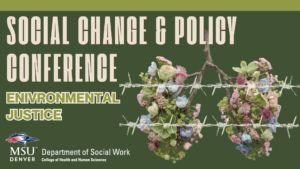
The Social Change & Policy Conference (SC&PC) is a hybrid gathering for students, practitioners, organizers, and community partners committed to creating meaningful change across systems, communities, and movements. This year’s conference centers Environmental Justice, exploring the frontline issues that disproportionately affect BIPOC communities, from AI data centers and ICE detention to clean air, water sovereignty and land back, and honoring the full ecosystem of strategies that drive change: policy and legislation, direct action, healing justice, storytelling, climate migration practice, and cross-movement coalition building.
Our keynote speaker this year is Beatriz Soto, Senior Director of Community Engagement at Conservation Colorado and Director of Protégete, whose work elevating Latino-led solutions to protect Colorado’s land, water, and air embodies the spirit of this year’s conference.
The MSU Denver Department of Social Work invites proposals for the 2026 Social Change & Policy Conference on Environmental Justice. This year’s conference brings together social workers, organizers, legal advocates, healers, storytellers, and frontline community members to explore environmental justice as a living, intersectional struggle — one that shows up in our caseloads, our neighborhoods, our courtrooms, and our bodies.
Environmental justice is not a single-issue movement. The forces that contaminate water in Indigenous communities, site AI data centers in low-income neighborhoods, detain climate migrants, and accelerate land loss are the same forces that deny reproductive rights, criminalize poverty, and exhaust the people trying to change things. This conference makes space for the full ecosystem of strategies that drive change, from legislation and litigation to direct action, healing, storytelling, and cross-movement coalition building.
This track centers on the formal levers of change; how organizers, advocates, and affected communities engage legislatures, regulatory bodies, and government agencies. Sessions explore both the possibilities and limits of policy pathways, especially for BIPOC communities often excluded from these processes.
Example topics:
This track honors the irreplaceable power of direct action, community organizing, and grassroots mobilization. From blockades to boycotts to base-building, sessions explore how people build collective power outside institutional channels, and why that pressure is often what makes institutional change possible.
Example topics:
Environmental racism is a form of ongoing trauma. This track centers healing justice: the understanding that liberation work requires tending to the whole person and community. Sessions explore trauma-informed practices, rest as resistance, and building organizations that can sustain change over generations.
Example topics:
Example topics:
• Somatic practices for climate grief and activist burnout
• Building a culture of care and accountability in your movement
• Healing from environmental harm: community storytelling circles
• How frontline BIPOC women are redefining movement sustainability
• Using joy as a form of resistance
This track explores the overlapping and interlocking nature of oppression, and the movement-building strategies that emerge when we refuse to silo our struggles. The same systems that poison water in Indigenous and economically excluded communities are connected to the forces that criminalize Black bodies, exploit undocumented labor, displace disabled people, and deny reproductive autonomy.
We invite proposals that center BIPOC-led organizing across issue areas, examine how coalitions are built and sustained across difference, and challenge practitioners to examine how their own organizations may inadvertently reproduce the fragmenting logic of the systems they’re fighting.
Example topics:
We strongly encourage proposals that:
Proposals meeting one or both criteria will receive priority consideration in the review process.
| Milestone | Date |
| CFP Opens | Friday, July 3, 2026 |
| Proposal Submission Deadline | Monday, August 17, 2026 |
| Notification of Acceptance | Friday, September 4, 2026 |
| Presenter Registration Deadline | Friday, September 19, 2026 |
| Digital Program Available | Friday, October 19, 2026 |
| Conference Date | Friday, October 30, 2026 |
All dates are subject to change. Check back for updates!