


Request Information
Ready to find out what MSU Denver can do for you? We’ve got you covered.
The Application window opens September 15, 2026.
Applications are accepted and reviewed as they are received.
Applications for Fall 2027 open September 15, 2026.
Applications for Fall 2027 close March 30, 2027.
Please monitor the website for future updates regarding specific dates.
The Master of Science in Clinical Behavioral Health with an emphasis in Addictions Counseling (BHAM) prepares ethical, culturally responsive, and evidence-based behavioral health counselors to serve individuals, families, groups, and communities in mental health, addiction, prevention, treatment, and recovery settings.
The program emphasizes professional counseling competencies aligned with counseling standards, including ethical practice, social and cultural diversity, human development, counseling and helping relationships, group work, assessment, research, advocacy, and clinical practice. Through academic coursework, experiential learning, and supervised clinical experiences, graduates are academically prepared to pursue licensure as Licensed Addictions Counselors (LAC) and Licensed Professional Counselors (LPC) in Colorado.
BHAM 5001 Advanced Ethical Practice 3 Credits
BHAM 5002 Social & Cultural Foundations 3 Credits
(Multicultural Counseling)
BHAM 5003 Development Across the 3 Credits
Lifespan
BHAM 5004 Career Counseling Theory & 3 Credits
Techniques
BHAM 5005 Theory & Techniques in 3 Credits
Helping Relationships
BHAM 5006 Group Counseling Theory & 3 Credits
Techniques
BHAM 5008 Research & Evaluation 3 Credits
BHAM 5009 Addiction Counseling, 3 Credits
Intervention, & Prevention
BHAM 5010 Addiction Counseling, 3 Credits
Intervention, & Prevention II
BHAM 5011 Clinical Supervision & 3 Credits
Advocacy
BHAM 5012 Diagnosis & Treatment 3 Credits
Planning
BHAM 5013 Statistical Analysis 3 Credits
BHAM 5014 Psychopharmacology, 4 Credits
Neurobiology, & Infectious
Diseases
BHAM 5015 Family Systems & Addictions 3 Credits
BHAM 5016 Trauma-Informed Care 3 Credits
BHAM 5020 Practicum I 6 Credits
BHAM 5021 Practicum II 3 Credits
BHAM 5031 Internship I: Addiction 6 Credits
Counseling
Total 61 Credits
We strongly encourage students to participate in academic advising in order to register for BHAM 5001, Advanced Ethical Practice. Your advisor must lift the hold in order for you to register for this course. Contact Dr. Jane Flournoy at [email protected] to arrange an advising meeting.
Find more details and information in our Academic Catalog.
Fall 2027 application window opens September 15, 2026.
Early Bird deadline: December 15, 2026
Final Deadline: March 30, 2027.
*Interview Dates: Jan. 20, March 4, May 6
*All interviews are scheduled to take place at 10:00 am. More details will be shared with applicants via email.
A masters degree is the minimal required degree to be eligible for licensure in Colorado. Employers look for a masters degree when promoting and/or hiring, especially for supervisory roles. A masters is also the minimum required degree for 3rd party reimbursement.
Choosing a graduate program is a significant and personal decision. We encourage you to meet with a faculty member for advising, look at the Clinical Behavioral Health course list, and reflect on your career goals as you decide the best academic home for your graduate pursuits.
Feel free to message us at [email protected] to request an appointment.
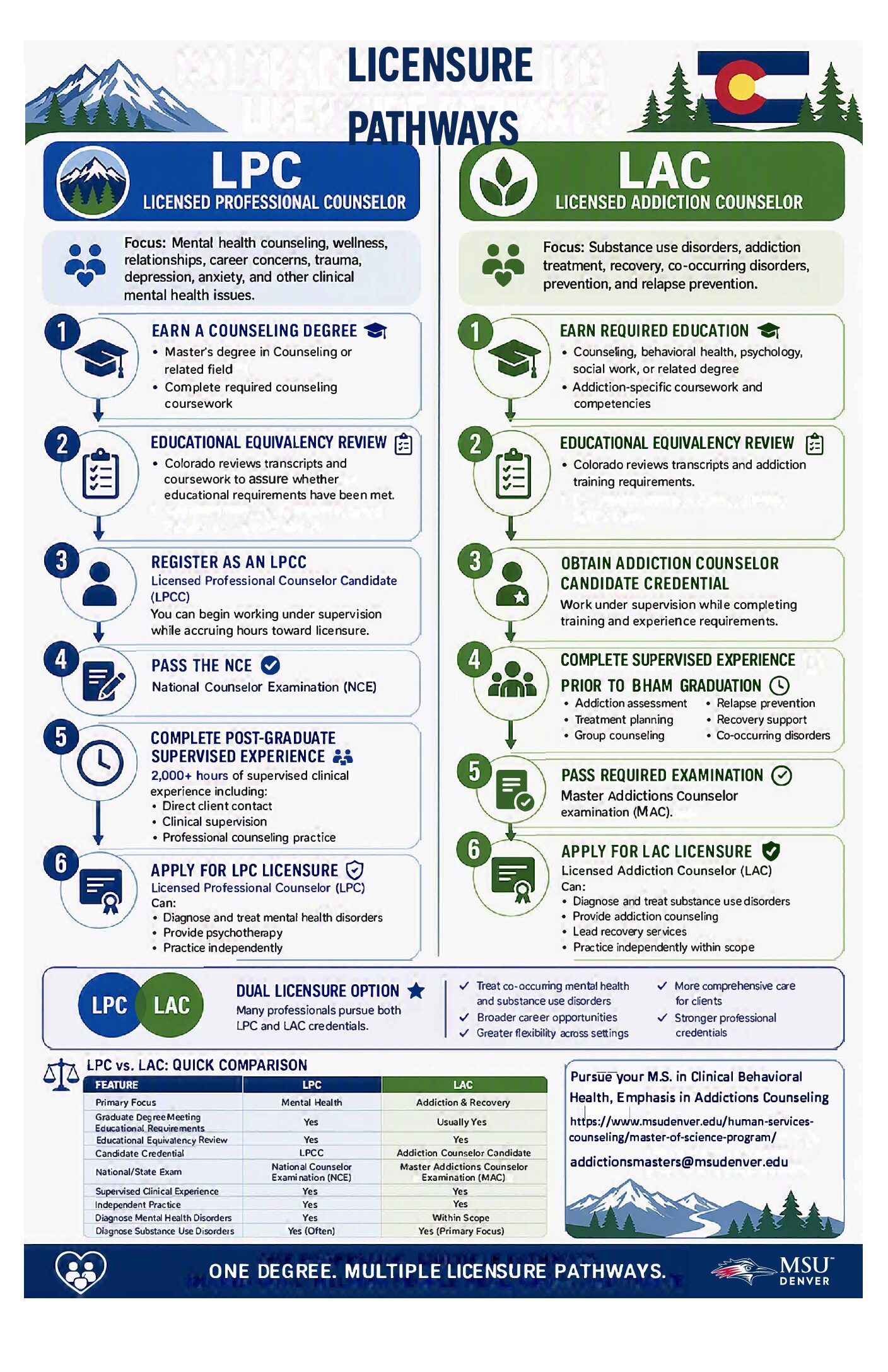
This program is unique in that students can earn dual licensure as both a Licensed Addiction Counselor (LAC) and a Licensed Professional Counselor (LPC).
Licensure allows clinicians to diagnose, treat, bill insurance companies, provide Employee Assistance Programs (EAP) services, and provide clinical and administrative supervision to a wider range of people, including interns and licensee candidates. Having dual licensure in both addictions counseling and mental health expands your areas of expertise.
The MSU Denver Department of Human Services and Counseling does not oversee licensure for Addiction Counselors or Professional Counselors. The state is the final authority on licensure, and students are responsible to follow state guidelines set forth by the state of Colorado.
Refer to Colorado’s Department of Regulatory Agencies (DORA) for more information:
This program is currently undergoing accreditation through NASAC (National Addictions Studies Accreditation Commission) and the Council for Accreditation of Counseling and Related Educational Programs (CACREP), although accreditation has not yet been earned. Additionally, MSU Denver is accredited through the Higher Learning Commission, or HLC.
CACREP accreditation is the quality standard for counseling and counseling related programs. We are in the process of aligning our policies and curriculum to meet CACREP standards and plan to apply for this accreditation once alignment has been complete. Although we are in the process of aligning our program to meet CACREP standards, we can not guarantee timely CACREP accreditation.
Currently, our program structure complies with the new standards for delivery methods for both F-1 and M-1 student visas and can, therefore, accept international applicants for admittance. Please note, if accepted, per the visa standards set by the United States government, F-1 and M-1 students in postgraduate programs at a college or university must take a full course of study as certified by the institution to keep their visa status.
Finally, this master’s program leads to eligibility for the license of License Addiction Counselor (LAC) and Licensed Professional Counselor (LPC), both of which are specific to Colorado. Although equivalency and portability of licenses within the country are possible, the program cannot guarantee any license portability or reciprocity outside of the state or out of the country.
Additionally, please visit MSU Denver’s International Student Support page.
The State of Colorado does not require individuals to be US citizens in order to obtain licensure as a Licensed Addiction Counselor (LAC) or Licensed Professional Counselor (LPC).
Courses are currently $585 per credit, and the program is 60 (LAC) to 66 (LAC + LPC) credits total. Total program ranges from $35,100 to $38,610. Prices may change over time.
Cost of program based on individual circumstances.
You can see the 24-25 Graduate Tuition and Fees Table on this webpage. Scroll down the page to find our program.
Our cohorts begin every fall. Students are admitted into the full-time track. The full-time track takes up to two and half to three years for completion, with courses offered in the spring, summer, and fall semester.
A limited number of part-time spots are available. Students must request and be approved for the part-time track which is completed in four years.
Our program is designed for working students. Classes are offered evenings and some weekends.
Because classes are skills-based, this program is not designed to be completed entirely online.
The program consists of traditional (on-campus), hybrid (part on-campus and part virtual), and online courses.
Many professional organizations offer scholarships. Colorado has a loan forgiveness program for LAC candidates. Click here for more information.
There are also loan forgiveness programs for students who work in non-profit agencies via the federal government. Information about the federal loan forgiveness program can be found here.
Students are encouraged to connect with the MSU Denver Office of Financial Aid and Scholarships to explore aid options.
Thank you for your service. We are pleased to offer you a waiver for the graduation application fee.
If you are a veteran, please send a picture or scan of your DD 214 Certificate of Release/Discharge From Active Duty document to [email protected] and let us know that you are requesting a waiver for the graduation application fee. MAKE SURE TO REDACT/COVER YOUR SOCIAL SECURITY NUMBER BEFORE SENDING THIS DOCUMENT TO US.
If you are a reservist or on active duty, please email us at [email protected]. State that you are requesting a waiver for the graduation application fee, and whether you are active duty or a reservist. We will schedule a time to meet virtually for verification purposes.
Fee waiver requests must be sent while the application window is open. This is generally mid-September through mid-April for the following fall semester.
The fee waiver code must be entered into your application BEFORE you get to the final page where payment is due. For this reason, we encourage you to request your fee waiver code sooner rather than later.
We also want to make sure that you are connected to our award-winning MSU Denver Veteran and Military Student Services. They are available to offer a wide variety of support and resources. Find their website here.
At this time the GRE is not required for application or admission to our Master of Science in Clinical Behavioral Health program.
Applicants accepted into our program whose undergraduate degree was in an unrelated field are encouraged to take our Foundations of Addiction and Mental Health Counseling course. The class is designed to lay the groundwork of our master’s program. The course is offered in the summer and is free.
While we prefer recommendation letters from professional and academic sources, the applicant ultimately gets to decide who they feel would best be able to speak to their professional and academic potential. Please ask your references to discuss what makes you suitable for a clinical program. If they have not observed you in a clinical role, we encourage applicants to have their recommenders highlight transferrable skills such as empathy, connection, listening skills, critical thinking, writing skills, and other personality traits that might help you to be successful in a clinical counseling program. Letters of recommendation should include any clinical experience, if applicable.
Applicants may contact the MSU Denver Writing Center to make an appointment for assistance with the grad school application essay. Current status as an MSU Denver student is not required.
Essays should address topics such as your motivations for pursuing a behavioral health degree, reasons for applying specifically to this program instead of other programs, and how this program matches your career goals. Help the review committee understand why you and our program are a good match for each other.
Applicants may submit unofficial transcripts for application review purposes. If accepted, official transcripts will be required and must be submitted for students to be able to register for their second semester.
Currently there is no requirement for you to be in personal therapy. Due to the nature of the program and work, however, students are strongly encouraged to ensure their own emotional needs have been sufficiently addressed.
MSU Denver students are eligible for no-cost services at the MSU Denver Counseling Center.
Applications are reviewed in the order in which they are received.
DORA regulates Licensed Addiction Counselors (LACs) and Licensed Professional Counselors (LPCs), and are mostly concerned with the safety and well-being of the public. Although DORA does not outline a minimum amount of time that they would expect to see counselors in recovery, two years is generally the standard. DORA wants to ensure that you are healthy and consistently able to provide quality services to clients.
Through the application process, you will be required to share your recovery status and additional information about your overall mental health and well-being. The Board will take into consideration the duration of sobriety and efforts made towards recovery. Please note that the Board has the authority to deny, suspend, and revoke licensure based on your ability (or lack thereof) to effectively and safely serve clients.
Graduate students can still be licensure eligible with a felony conviction depending on the charge and how recently it occurred. Ultimately, it is The Board’s decision to approve or deny licensure.
No. Due to licensing and accrediting requirements, students must complete all coursework and field experience hours while enrolled in the program.
Unfortunately not. CAT/CAS courses usually consist of community-based workshops and don’t have the same depth or breadth as our master’s level courses.
In addition, accreditation requires all courses to be completed at the master’s level, therefore community courses do not count towards credit for your graduate degree.
Talk to your academic advisor if you have graduate-level transcripts you’d like to have reviewed.
Practicum I hours will be completed on campus under the supervision of course faculty, so it will not be possible to use your place of employment for Practicum I. Practicum II and Internship hours are completed in the field. Students may be eligible to use their employment for these opportunities providing they are engaging in new learning and can demonstrate fulfillment of program objectives and competencies. Please reference the Student Handbook for more information on concurrent employment.
Practicum and Internship hours can be applied toward your LAC if you have the appropriate supervision. However, all LPC hours must be accrued post-graduation. LAC hours are accrued over a period of at least 18 months, and LPC hours are accrued over a period of at least 24 months. If you still need additional clinical hours for your LAC after graduation, you may apply those work hours towards both your LAC and LPC if your supervisor is appropriately licensed for both LAC and LPC supervision.
LACs can work in multiple settings ranging from hospitals, acute care facilities, outpatient treatment, residential, withdrawal management, and private practice.
While there are no guarantees, the expected salary range for an LAC/LPC can range from $50,000 to more than $70,000 in Colorado according to ONETONLINE.org.
Our cohorts only begin in the fall semester.
We are not able to respond to requests for information regarding the reasons for an applicant’s denial. In general, if a student applied with a low Grade Point Average (GPA), they can take 9 credits at the college or university level and reapply, assuming they have earned a GPA of 3.0 or higher. If a student had a 3.0 GPA and was not accepted, they can re-apply at a later date with a different essay and letters of reference.
Make sure to thoroughly read the acceptance letter you received. It will have many important pieces of information and next steps for you, starting with signing the enrollment agreement to ensure your spot in our program.
We require students to participate in academic advising in order to register for their first semester of classes. Your advisor must lift holds in order for you to register. After setting up your student account and MSU Denver student email, schedule an advising appointment with Jane Flournoy here.
This section serves as a resource for prospective internship sites, approved internship sites, and students seeking internship resources.
All internships must be conducted in keeping with the MSCBH Student Handbook. Please click here to review the handbook and related internship requirements.
For prospective internship agencies:
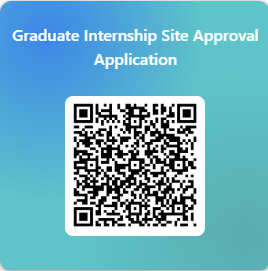
If you are a community behavioral health agency that offers mental health and substance use disorder services, you have a site supervisor with an active license as an addictions counselor (LAC), and you are interested in having counselors-in-training as interns, please fill out this form or scan the QR code below.
Thank you for your interest!
Site Supervisor Orientation Information:
For all new sites, please watch the following orientation video to ensure a successful partnership!
You can also access the orientation via a slide deck here.
Please click here to confirm you have watched the orientation video.
For students seeking internship resources:
Please click here for a list of currently approved internship sites.
Please click here for information about selecting an internship site.
Questions?
Please contact Dr. Jane Flournoy at jaflournoy@msudenver.edu.
Find the State of Colorado Handbook for Addiction Counselors (commonly referred to as the CAC handbook) here.
Do you have questions about our Master of Science in Clinical Behavioral Health, emphasis in Addictions Counseling program?
Email us at [email protected].
Please find our department’s main contact information here.