
Request Information
Ready to find out what MSU Denver can do for you? We’ve got you covered.
Building it so "they" will come might work for a cornfield in Iowa, but at MSU Denver we should question who “they” are and who we may be keeping out. In this issue, take a trip to Troy, NY, learn about the benefits of accessible design, and explore ways you can help build a more accessible campus. Let's build it accessibly, so all can come.
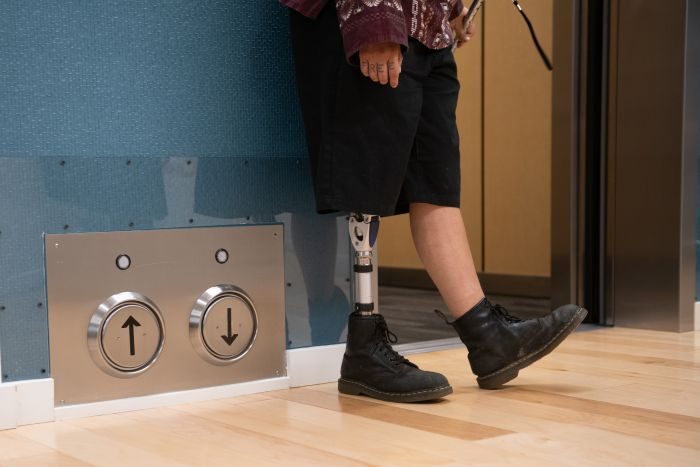
Elevator call buttons at floor level can be used by anyone. Image by the Disabled and Here Project
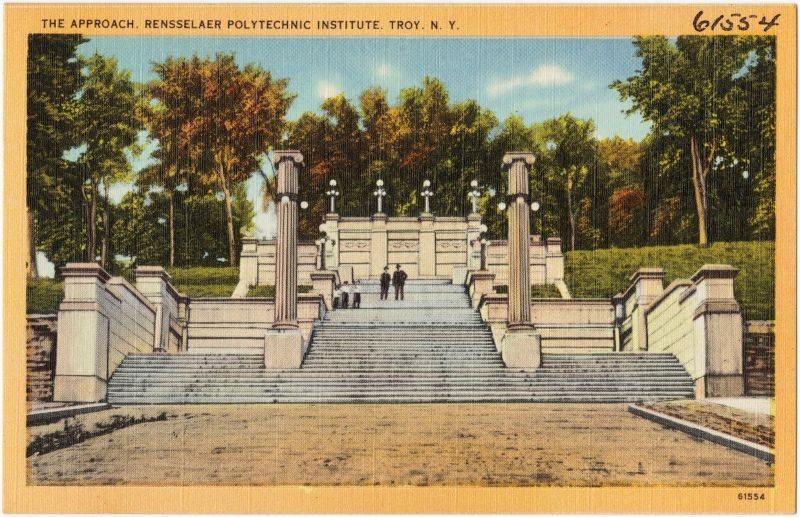
The postcard above depicts the Approach to Rensselaer Technical Institute. In Academic Ableism, Jay Timothy Dolmage offers this description of the image:
“The steps are made of a light gray stone. They are about 20 meters wide on their bottom flight, which is at the forefront of the photo, so that we look up from the very bottom. The steps narrow further up, at the point where two large cylindrical marble columns stand. The steps continue to climb up to an imposing set of gates. Behind these gates there are green trees and foliage and, we assume, the university. Five people stand up near the very top of the steps and they look very small, giving perspective on just how steep and massive the approach is.”
Imagine being a prospective student, parent, faculty or staff at the bottom of the Rensselaer steps (above), could you climb them? How daunting would they feel if you used a mobility device (walker, cane, wheelchair, etc.)?
These steps represent the barriers to education. For people with a disabilities, encountering barriers is an unfortunate truth of daily life, and they are often forced to prioritize which barriers to address and which ones to avoid. A 2016 UK Study found that 71% of users with disabilities will abandon a website that is difficult to use (The Click Away Pound Survey). How many students are not enrolling, transferring elsewhere, or simply dropping out do to inaccessible content and practices?
Frustratingly, there is no clear answer. The perceived lack of students with accommodations is not indicative of the number of students with disabilities. Not all students with disabilities are diagnosed or choose to disclose their disabilities (especially with the recent attempts to connect Tylenol to Autism). Therefore, we cannot know conclusively whether a student dropped, failed, or withdrew from a course due to barriers they encountered. By striving to make content, systems, and practices accessible, we hope to remove as many barriers as possible so no student has to rely on documentation or disclosure. If we build it, some will come. If we build it accessibly, all can come.
Now return to steps at Rensselaer. If you could climb them now, could you climb them every day? What if you had long COVID? Were 6-months pregnant? Recovering from surgery? Sprained your ankle playing flag football? A ramp would increase access for the entire community.
Here are some other ways accessibility benefits everyone: