
Request Information
Ready to find out what MSU Denver can do for you? We’ve got you covered.
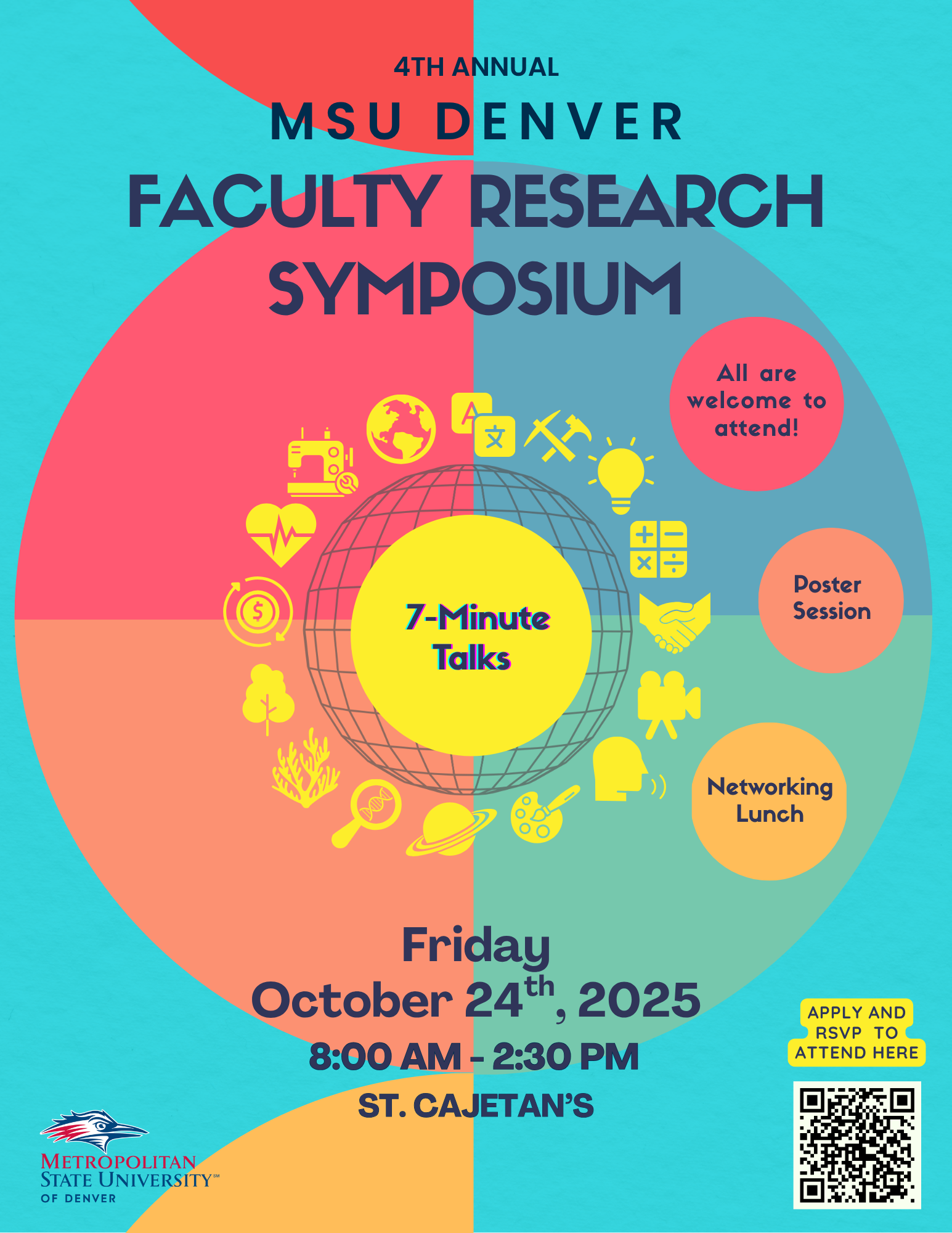
October 24, 2025
St. Cajetans
Check-in and Light Breakfast: 8:00-8:30am
Welcome and Keynote: 8:30-9:00am
Session I: 9:10-10:10am
Session II: 10:20-11:20am
Remarks by Provost Matt Makley: 11:20-11:30
Poster Session and Break: 11:30-12:00pm
Session III: 12:00pm-1:00pm
Lunch: 1:00-2:30pm (provided for registered attendees)
Undergraduate Research and Creative Scholarship Program
Center for Teaching, Learning and Design
Center for Individualized Learning
College of Aerospace, Computing, Engineering, and Design (CACED)
College of Health and Human Sciences (CHHS)
College of Letters, Arts, and Sciences (CLAS)
Computer Sciences
Based on a 2024 faculty learning community project, this study takes a mixed-method approach to examine student perceptions and performance as they relate to the use of Generative AI (Gen-AI) tools for course assignments. The breadth of disciplines and lower-division/upper-division students revealed distinct concerns about Gen-AI, yet no strong patterns related to Gen-AI usage and academic performance were revealed.
Writing Center
The character of Sibaso in Yvonne Vera’s novel The Stone Virgins represents the consequences of war and its trauma, exhibiting signs of both PTSD and TBI. Unable to cope after the war for independence, Sibaso becomes mute, psychologically unsound, and inhuman, embodying the psychological toll of experienced brutality.
Chemistry and Biochemistry
In this research, we investigate Lewis Acid (LA)-bound, high-valent non-heme (nH) Mn4+-oxo complexes (LA=Sc³⁺, In³⁺, Al³⁺). The synthesized [(BnTPEN)Mn⁴⁺O]ᶻ⁺–(LA)ₓ complexes were electrochemically and spectroscopically characterized to investigate how the identity of the LA influences redox potentials and excited-state lifetimes. Results suggest design principles for earth-abundant photosensitizers exploiting spin-forbidden d–d transitions with microsecond photoactivity.
Exercise and Sport Sciences, Hospitality, Education
This presentation explores a teaching case study integrating Transformative Sustainability Learning (TSL) and the Community of Inquiry (CoI). Situated in fitness contexts, the project highlights interdisciplinary collaboration across sport management, exercise science, and culinary nutrition, demonstrating how sustainability education can foster transformative learning, community engagement, and applied industry practice.
Engineering and Engineering Technology, Collaborators at University of Florida and Cameroon, Africa
This presentation describes our research for designing and analyzing rural water supply networks to help provide clean water for those lacking. We aim to help with real water systems that struggle with taps providing water only when tanks are full, meager resources, and ensuring long term sustainable clean water.
Psychology
This presentation shares survey and interview findings on sexual choking—the practice of restricting the flow of oxygen to the brain through strangulation or pressure to the neck during sex—examining links between trauma history, porn use, and the consent–compliance–coercion continuum.
Art
This presentation reports on outcomes from a collaborative, cross-disciplinary and intergenerational research trip to Mexico City to collect pedagogical material to integrate across the Art History program. Resources were developed on location by faculty and student teaching assistants, making the case for the value of experiential field work as a high impact practice.
Sociology and Anthropology
This presentation examines conceptual issues that emerged in designing and producing a film centered on student-researchers’ encounters with sites associated with the development of the atomic bombs dropped on Hiroshima and Nagasaki as well as the wartime internment of Japanese Americans.
Industry Partnerships
Grounded in MSU Denver’s CADRE values, this session shares how Improvement Science and Participatory Action Research empowered first-generation Hispanic female STEM students to strengthen critical thinking. Through community-driven workshops, equitable access, and respect for diverse voices, participants will see how excellence in culturally responsive practices fosters student success and resilience.
Art
This case study explores the rise of Brutalism in User Interface (UI) design—why this trend is resonating with emerging designers, how it challenges Big Tech norms, and what principles and histories underpin its aesthetic. We’ll unpack its forms, impact, and potential as a raw, honest alternative in contemporary digital design.
Biology
This presentation shares a multi-omics approach to study the conservation genetics of cold water fish in Colorado. Focusing on the greenback cutthroat trout, Colorado’s state fish that now suffers from inbreeding depression, this presentation will explain multi-omics and how this approach is used to discern the adaptive strengths and limitations of various populations of fish.
Social Work
Using data from qualitative interviews with 42 GLBQ+ people and their families, we examine the potential benefits of participating in qualitative interviews about intergenerational family relationships.
Special Education, Early Childhood , and Culturally and Linguistically Diverse Education
This presentation introduces arts-based pláticas—a decolonial, community-centered method pairing diálogo y confianza with creative making, featuring an educator’s “tree of life” vignette and three quick strategies (Ground, Make and Witness, and Close the Loop). Participants will receive a one-page sheet and leave ready to host healing, identity-affirming circles in their context.
Nutrition, Social Work
The Becoming Culturally Aware Leaders Scholars program, a collaboration between MSU Denver and Cal Poly Pomona Nutrition programs and the MSU Denver Social Work Department, is using storytelling to train future dietitians to become culturally responsive leaders/advocates, and mentors. The project and pre-program assessment results will be presented.
Art, Earth and Atmospheric Sciences
“Ruminant” uses science and paintings to explore changes in soil chemistry around bison carcasses at Colorado’s Genesee Park.
Computer Sciences
This poster presents the Sustainability Hub, a statewide platform combining conversational AI, community asset mapping, and open data to support local decision-making. We introduce Bili, a natural language assistant, and BiliCore, a model evaluation framework, highlighting how co-design and participatory methods connect people, technology, and place.
Exercise and Sport Sciences
This poster explores how grit, political skill, and job engagement intersect to shape success in the modern sport workplace. It highlights the value of perseverance, relational awareness, and organizational commitment for professionals navigating the challenges and opportunities of today’s sport industry.
Center for Multicultural Engagement and Inclusion
This study explores how Cultural Greek-Lettered Organizations (CGLOs) influence academic success among students of color at PWIs, using Strayhorn’s (2019) Sense of Belonging framework. Findings highlight how CGLOs foster resilience, motivation, and connection through culturally affirming peer support and identity-centered engagement.
Earth and Atmospheric Sciences, Mathematics and Statistics
Blind and low-vision individuals benefit from ride-hailing’s flexibility but face frequent discrimination, especially guide dog users. We conducted an online survey and found Lyft was rated slightly higher than Uber. While ride-hailing expands mobility, it is the mode with the most reported discrimination, highlighting accessibility challenges and policy implications for equitable transportation.
Center for Teaching, Learning and Design
Faculty are asked to “cheat” with generative AI to experience its speed, nuance, and limitations. This poster presents results from ~10 CTLD department workshops with playful yet serious discussion about academic integrity, assessment design, and student learning. We highlight faculty insights and raise urgent questions about gAI’s impact on teaching.
Earth and Atmospheric Sciences
We address forest degradation—subtle losses in quality and biomass—using satellite time series. Unlike single-pixel methods, our model integrates spatial context to distinguish seasonal variation from true decline across remote regions. Experiments show improved accuracy and earlier detection at large scales, advancing monitoring and informing timely conservation and decision-making policies worldwide.
Biology
This poster will discuss using the sea anemone, Exaiptasia diaphana, as a model for studying the mechanisms involved in coral symbiosis establishment and breakdown (bleaching). The use of these animals in the classroom to expose students to molecular biological research and the tools used in molecular laboratories will be shared.
Graduate Student, Health Professions
AI has enhanced the accuracy of diagnosis and efficiency of patient treatments, proactive risk assessment, customized treatment regimen, and cost-effective drug design. Results from a survey about AI-powered Clinical Decision Support Systems (CDSS) will be shared that suggests AI-CDSS tools hold promise for
improving decision-making and efficiency.
Graduate Student, Chemistry and Biochemistry
Liquid Organic Hydrogen Carrier (LOHC’s) are promising hydrogen carriers; however, the release of H₂, known as dehydrogenation, has high desorption enthalpies and the bulk heating causes production of unwanted by-products. This research focuses on using light for localized heat delivery with LED’s which can reduce the energy input by minimizing bulk heating, allow for scale-up, and lastly improve selectivity towards H₂ release over undesired by-products.
Graduate Student, Chemistry and Biochemistry
The excited-state photophysics of non-heme (nH)-Mn(IV)-oxo complexes are not well understood. To remedy this, steady-state and transient spectroscopies, including Ultraviolet-Visible (UV-Vis) Spectroscopy and Femtosecond-Picosecond Transient Absorption Spectroscopy (TAS), are used to gain mechanistic insights into the excited states of (nH)-Mn(IV)-oxo complexes with different Lewis Acids.
Graduate Student, Chemistry and Biochemistry
Activated carbon is a porous material valued for its sorbent properties; however, its use in hydrogen storage is limited due to poor thermal conductivity caused by irregular pore structure and low density. In this study, densification and structural reorganization of the sorbent were achieved.
Graduate Student, Chemistry and Biochemistry
Approximately 3.2 million metric tons (MMT) methane leak out from inactive oil and gas wells in the U.S., spurring interest in developing methods for converting methane into value-added fuels. This work demonstrates TiN–TiO2 core-shell photocatalysts decorated with Pd/Cu alloys, showing promising ethane conversions using visible-light.
Mike Heathcote & Tim Hawkins, Office of Sponsored Research & Programs (OSRP)
Gyasi Evans & Sara Satkowiak, Auraria Library
Graduate Student, Health Professions
Emergency departments (ED) are uniquely high-pressure environments where registered nurses (RN) juggle unpredictable acuity and constant throughput. Within these conditions, mental health resources are often difficult to access at the moments they are most needed. With new and emerging technology, Artificial Intelligence (AI) offers a possible solution to acute mental distress.
Industrial Design
An exploration of controlled biodeterioration in furniture design, where objects evolve, decay, and transform over time. Rooted in regenerative design and Darwinian principles, these living pieces embrace impermanence—growing more evocative as they fade into poetic, ghostly remnants of their former selves.
Computer Sciences
ChatGPT, on average, produces 1.38% insecure cryptographic code responses across these languages. Notably, Java exhibited the highest percentage of cryptographic API misuses, with 3.39% of the generated code responses containing security flaws.
Sociology and Anthropology
The presentation focuses on Altar Q, an Ancient Maya sculptural text (late 700s, Copán Honduras). Building on nearly two centuries of Altar Q scholarship and recent work to decipher its textual hand signs, this presentation will showcase Altar Q as one of the world’s great ancient texts.
Chemistry and Biochemistry
This presentation details the design and synthesis of novel manganese-based complexes where Lewis acid binding tunes photophysical properties. Characterization reveals control over excited-state dynamics, establishing design principles for efficient, earth-abundant photosensitizers for light-harvesting applications.
Chemistry and Biochemistry
My lab develops DNA-based electrochemical biosensors that detect cancer markers, pathogens, toxins, and pollutants with speed and precision. This talk highlights both the science of aptamer biosensor design and the process of engaging undergraduates in meaningful research that leads to discovery and publication.
Psychological Sciences
Students who are parents, make up more than 10% of MSU Denver’s student body, but they are an invisible population. This presentation will share about two approaches to telling the stories of these students – one from feminist folkloristics and one from psychology. Implications for supporting student success will be discussed.