
Request Information
Ready to find out what MSU Denver can do for you? We’ve got you covered.

In my research, I aim to change the instructional culture in STEM at MSU Denver to reflect value of inclusion and to embrace the expectation that all students are capable of succeeding. An important component of this change is the use of learner-centered, evidence-based instructional practices such as active learning in classrooms.
Through this study, I and my collaborators, Dr. Cynthia Erickson (from the Psychological Sciences department) and Dr. Shalini Srinivasan (from the Chemistry department) are attempting to explore the use of and measure the effectiveness of transformational teaching practices, including active learning, in STEM courses. Furthermore, we are using the lens of intersectionality to frame the marginalization experienced by minoritized groups (in STEM classes) at the intersection of race, gender, sexual orientation, class, and other identities.
Academic Background
I earned my Ph.D. in Ecology and Evolutionary Biology from the University of Tennessee–Knoxville, following a B.S. in Conservation Biology from the University of Wisconsin–Madison.
I bring extensive leadership and field research experience, particularly in challenging island environments. I have led international field teams and conducted research across the U.S., the Caribbean, the Adriatic islands of Croatia, and New Zealand, studying a range of taxa including birds, lizards, snakes, and other wildlife.
For my graduate studies, I joined Dan Simberloff’s lab at the University of Tennessee. My dissertation focused on the impact, control, and evolutionary consequences of the small Indian mongoose (Herpestes auropunctatus), an introduced predator. I conducted fieldwork across multiple Croatian islands—some with mongooses and some without—surveying native birds, reptiles, amphibians, small mammals, and introduced rats. This research required a wide array of field methods, as well as intensive coordination and logistics. I also collaborated with local hunters across nine islands to collect specimens, a process that demanded cultural sensitivity, negotiation, and persistence, particularly because many of these individuals had never worked with scientists before. As part of this project, I employed GIS to analyze spatial data and conducted radio-tracking of target species.
After earning my Ph.D., I worked as adjunct faculty and volunteered at the U.S. Fish and Wildlife Service’s Austin Field Office, where I contributed to habitat management and recovery plans, five-year reviews, and stakeholder meetings concerning endangered species conservation and land management strategies.
I later completed a one-year fellowship in New Zealand, where I developed and tested novel approaches for controlling invasive mammals such as rats, mice, stoats, ferrets, and feral cats. My work involved both lab and field testing of self-resetting traps, new toxins, baits, and lures. Collaborating with interdisciplinary teams and Māori communities, I helped develop control strategies that were not only scientifically effective but also culturally informed and broadly acceptable to local stakeholders.
Although I was initially encouraged to pursue a research-focused academic career with minimal teaching responsibilities, my experience in the classroom led me to a different path. I discovered that my true passion lies in teaching.
With a strong commitment to inclusive, student-centered education, I aim to make science engaging, accessible, and relevant – especially for students from historically underrepresented backgrounds. I continually adapt my teaching and research practices to reflect new ideas, emerging technologies, and the evolving needs of students at MSU Denver and the world around us.
Hobbies
Dr. Barun is happiest outdoors, no matter the season—whether she’s hiking through the woods, relaxing on the beach, or digging into her vegetable garden. In the winter, she loves staying active with cross-country skiing and enjoying the fresh, snowy air. Travel is a big part of her life too, especially trips to Croatia to visit family and soak in the beauty and traditions of her roots. But what she loves most is spending time with her kids in New York and Atlanta—sharing meals, catching up, and making memories together.
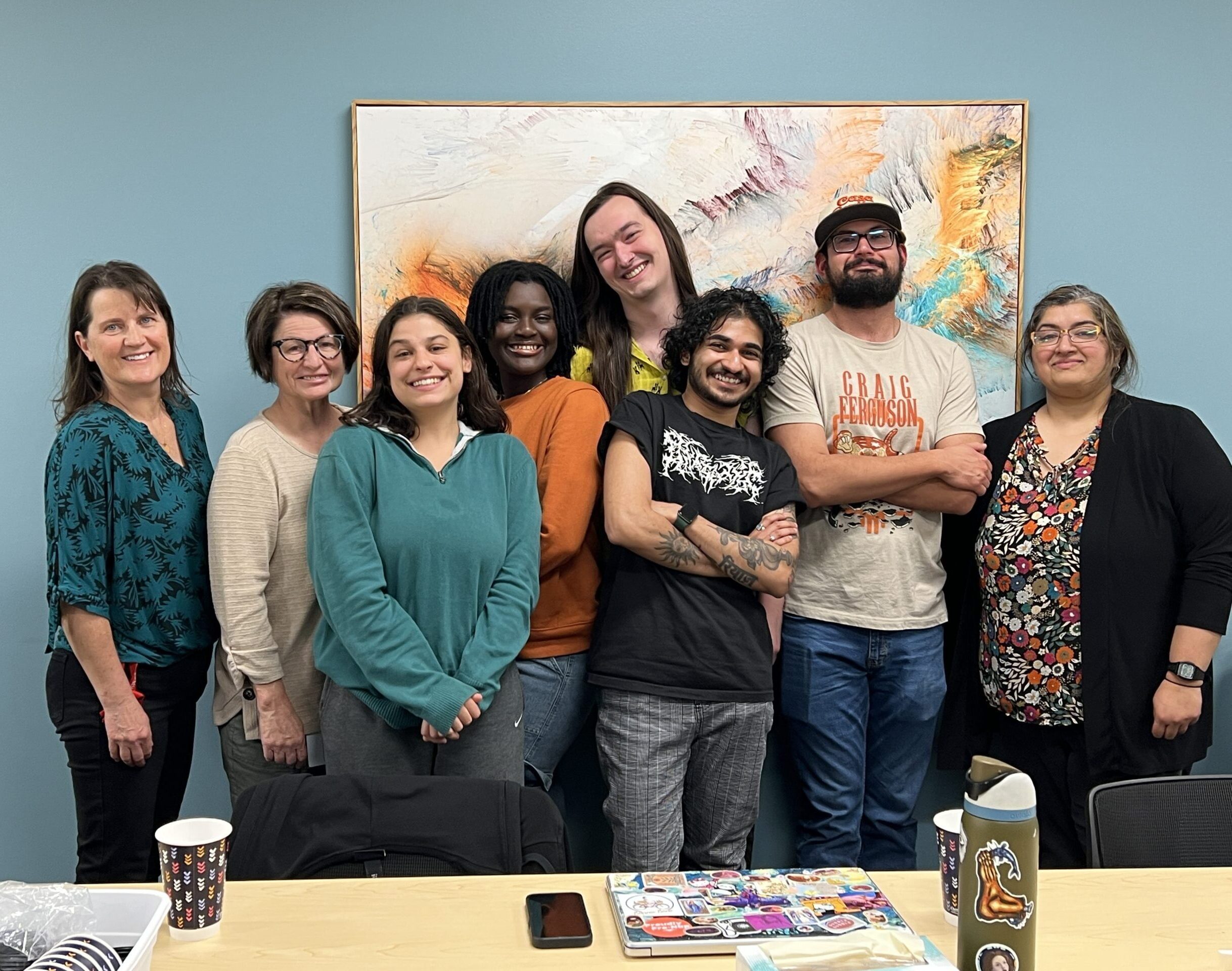
From left to right, Dr. Arijana Barun (BIO), Dr. Cynthia Erickson (PSY), Sarah Rones, Nana Akua Adu Owusu, Nicholas Miller, Ayden Joshi, Brandon Martinez, and Dr. Shalini Srinivasan (CHE).
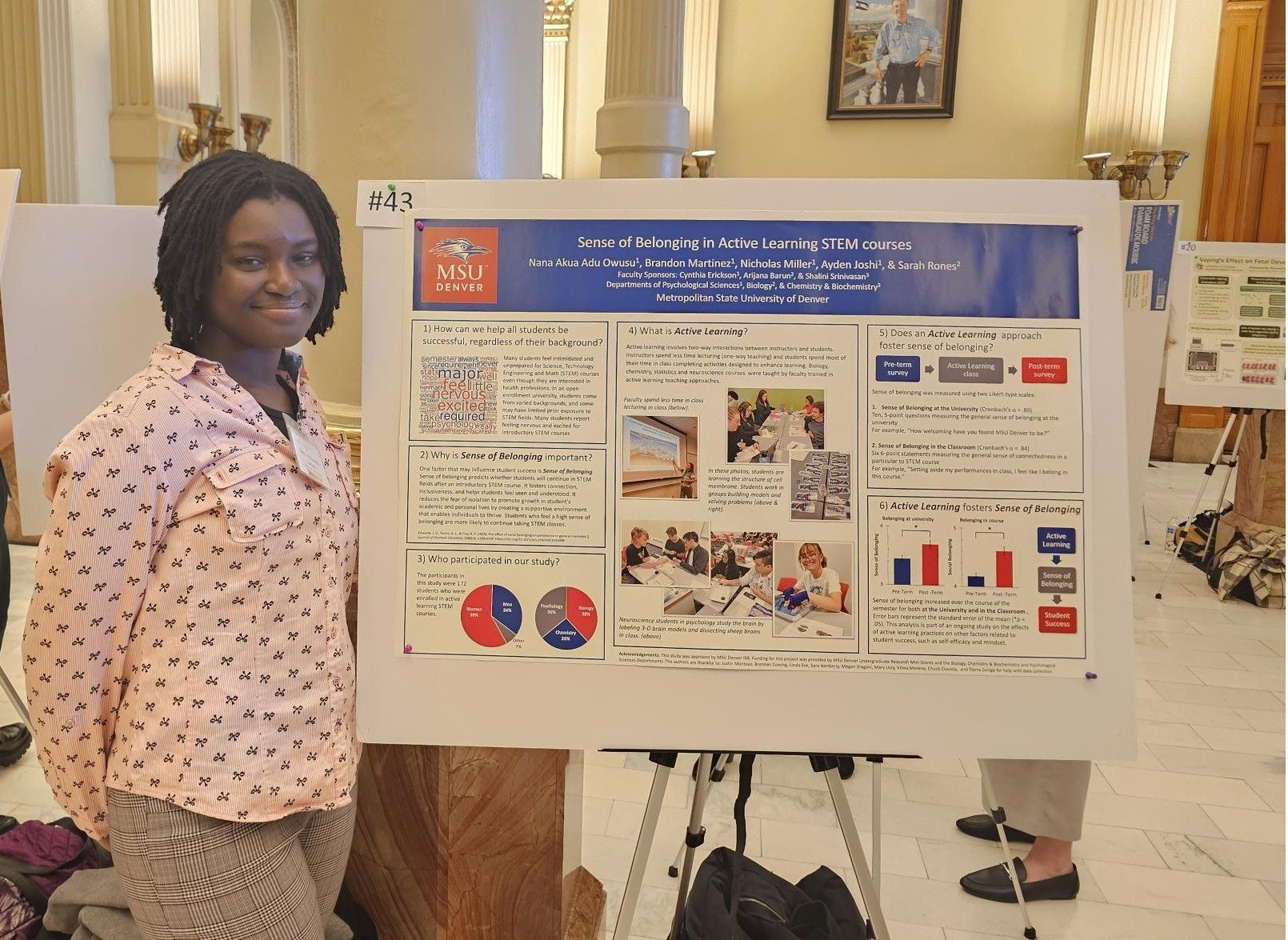
Nana Akua Adu Owusu presents at STEM Poster Day at the Colorado Capitol; Nana plans on applying to medical school.
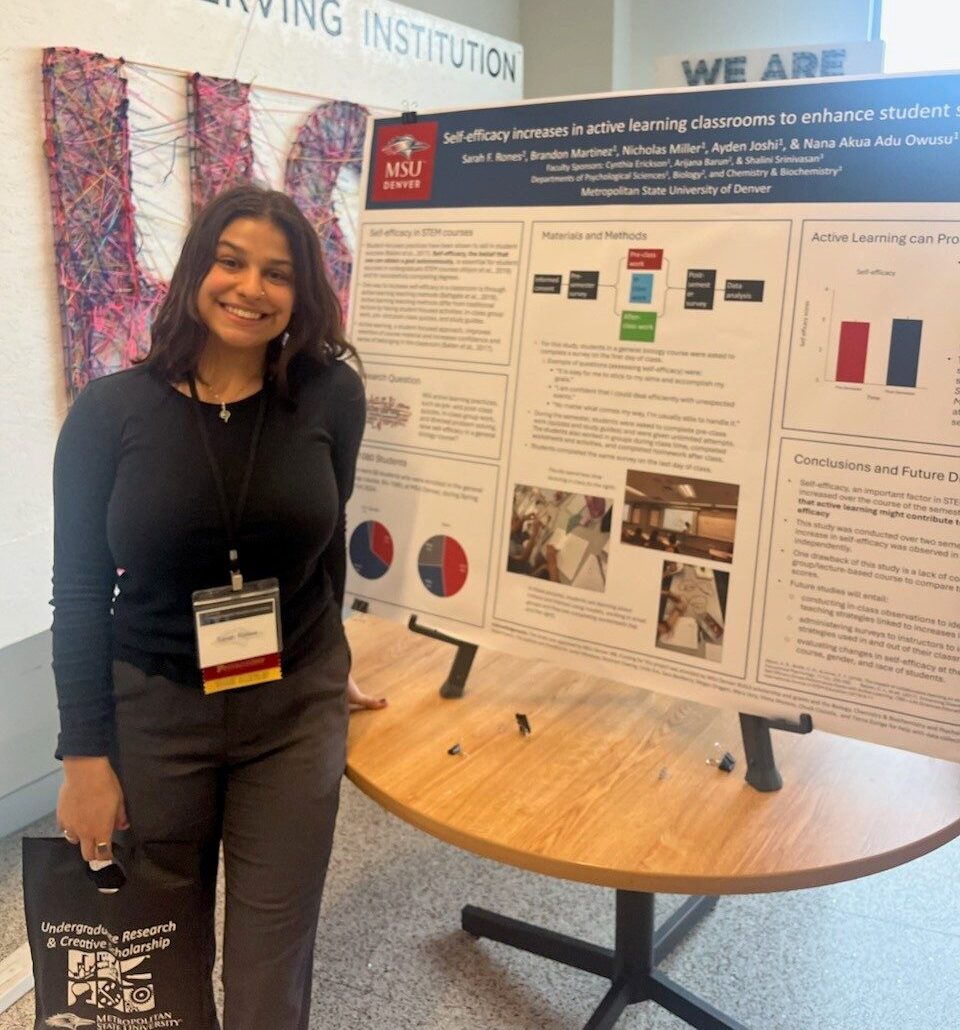
Sarah Rones presents her poster at the 2025 MSU Denver Undergraduate Research Conference. Sarah is a biology and a secondary education major who wants to teach anatomy and physiology.
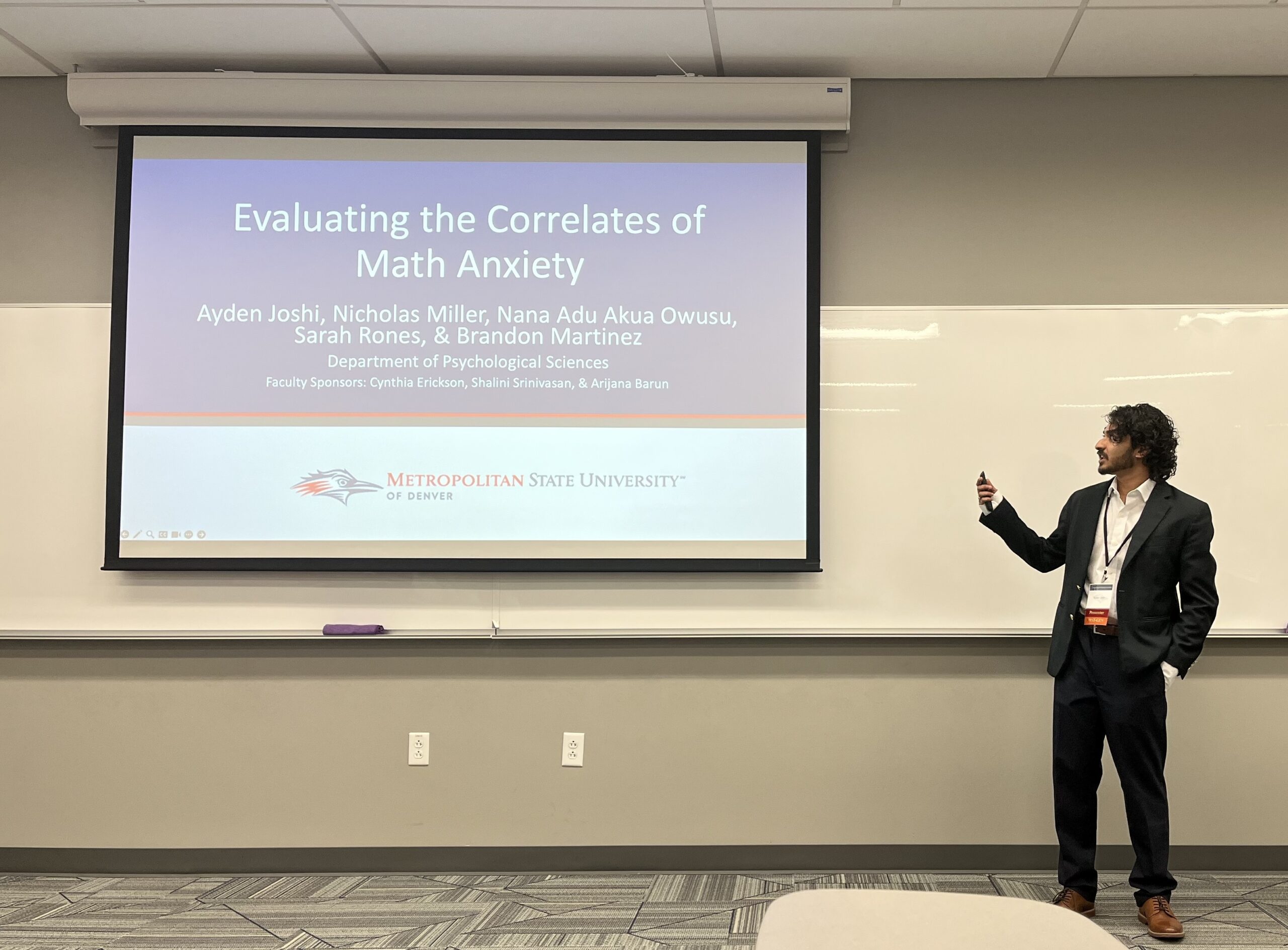
Psychology major, Ayden Joshi, presents on the correlates of math anxiety at the MSU Denver Undergraduate Research Conference.
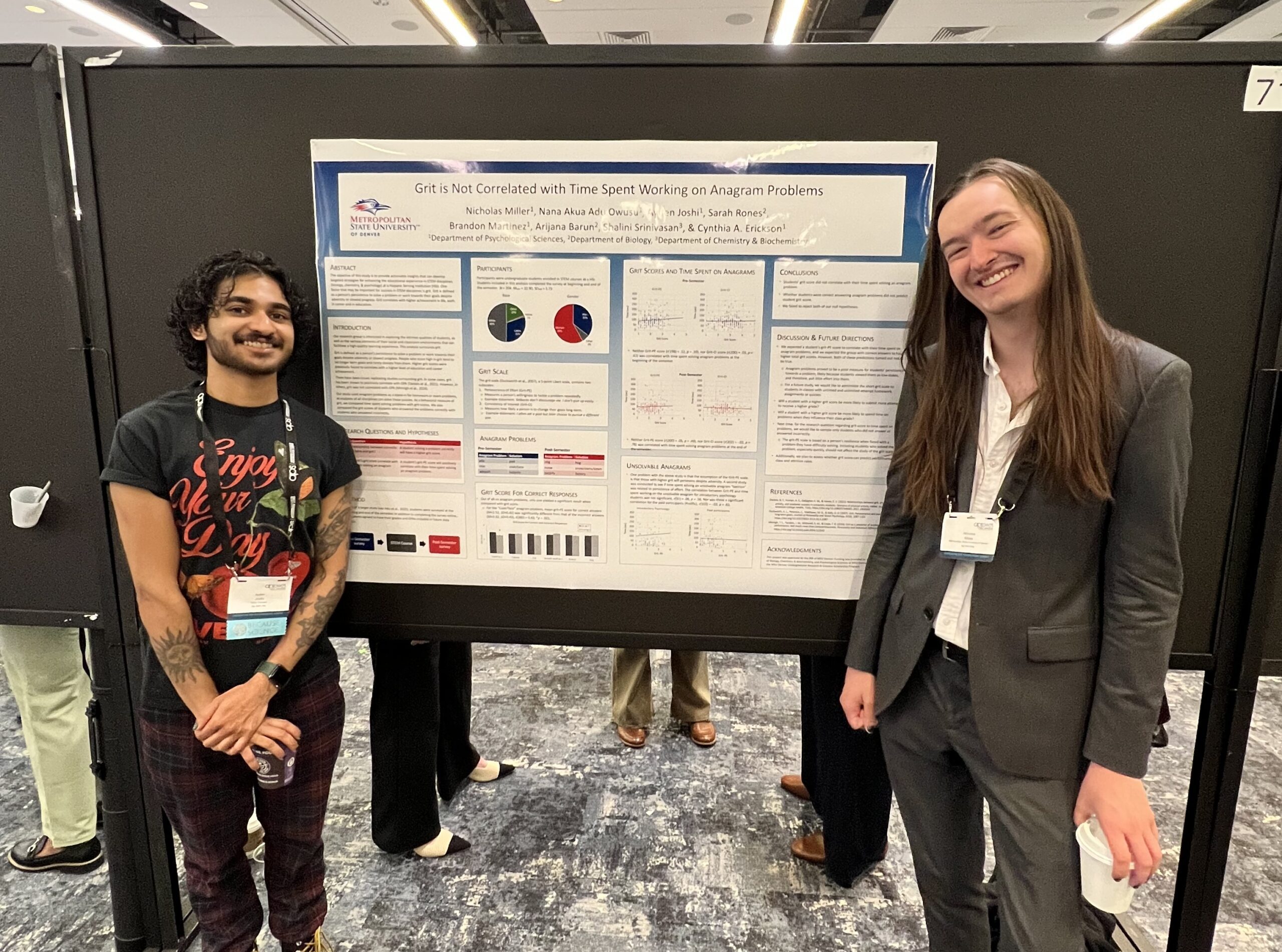
Ayden Joshi and Nicholas Miller present their poster at the Association for Psychological Science conference. Both Ayden and Nick plan to apply for medical school.
Griffis‐Kyle, K. L., LeVering, K., Vega, A., Perez‐Martinez, C. A., Barun, A., & Perry, G. (2023). Reproductive niche differentiation in syntopic tropical tree frogs (Agalychnis). Biotropica, 55(1), 19-23.
Lefort, Marie-Caroline; Cruickshank, Robert H.; Descovich, Kris; Adams, Nigel J.; Barun, Arijana; Emami-Khoyi, Arsalan; Ridden, Johnathon; Smith, Vikki R.; Sprague, Rowan; Waterhouse, Benjamin; Boyer, Stéphane. 2022. Blood, sweat and tears: a review of non-invasive DNA sampling. Peer Community Journal, Volume 2, article no. e16. doi : 10.24072/pcjournal.98. https://peercommunityjournal.org/articles/10.24072/pcjournal.98/
Ogilvie, S., Sam, S., Barun, A., Van Schravendijk-Goodman, C., Doherty, J., Waiwai, J., . . . Eason, C. 2019. Investigation of tutin, a naturally-occurring plant toxin, as a novel, culturally-acceptable rodenticide in New Zealand. New Zealand Journal of Ecology, 43(3), 1-8.
Barun, A., Simberloff, D., Meiri, S., Tadic, Z., and Tvrtkovic, N. 2015. Possible character divergence of an introduced mongoose and native marten on Adriatic islands, Croatia. Journal of Biogeography. 42(12): 2257-2269.
Murphy, E., Sjoberg, T., Barun, A., Aylett, P., MacMorran, D., Eason, C., 2014. Development of re-setting toxin delivery devices and long-life lures for rats. In: Timm, R.M. (Ed.), 26th Vertebrate Pest Conference Proceedings, Hilo, Hawaii.
Barun, A., M.L. Niemiller, B.M. Fitzpatrick, J.A. Fordyce, and D. Simberloff. 2013. Can genetic data confirm or refute historical records: the island invasion of the small Indian mongoose (Herpestes auropunctatus). Biological Invasions 15(10): 2243-2251.
Barun, A., “The small Indian mongoose (Herpestes auropunctatus) on Adriatic Islands: impact, evolution, and control. ” PhD dissertation, University of Tennessee, 2011. http://trace.tennessee.edu/utk_graddiss/947
Barun, A., D. Simberloff, N. Tvrtković. 2011. Impact of the introduced small Indian mongoose (Herpestes auropunctatus) on abundance of the small mammal community and activity time of the introduced ship rat (Rattus rattus) on Adriatic islands, Croatia. NeoBiota 11:51-61.
Barun, A., C. C. Hanson, K. J. Campbell, and D. Simberloff. 2011. A review of small Indian mongoose management and eradications on islands. In: Veitch, C. R.; Clout, M. N. and Towns, D. R. (eds.). Island invasives: eradication and management, pp. 17-25. IUCN, (International Union for Conservation of Nature), Gland, Switzerland.
Barun, A. and D. Simberloff. 2010. Carnivores. In: Simberloff D., and M. Rejmanek (eds). Encyclopedia of Biological Invasions. University of California Press, Berkeley.
Barun, A., D. Simberloff, and I. Budinski. 2010. Impact of the small Indian mongoose (Herpestes auropunctatus) on native amphibians and reptiles of the Adriatic islands, Croatia. Animal Conservation 13: 549-555.
Barun, A., I. Budinski, and D. Simberloff. 2008. A ticking time-bomb? The small Indian mongoose in Europe. Aliens 26: 14-16.
Thulin, C.G., D. Simberloff, A. Barun, G. McCracken, M. Pascal, and A. Islam. 2007. Genetic divergence in the small Indian mongoose (Herpestes javanicus), a widely distributed invasive species. Molecular Ecology 15: 3947.
Levering, K., G. Perry, A. Barun, and J. Lazell. 2007. Alsophis portoricensis anegadae scavenging. Herpetological Review 38(2): 203.
Barun, A., G. Perry, R.W. Henderson, and R. Powell. 2007. Alsophis portoricensis anegadae (Squamata: Colubridae): Morphometric characteristics, activity patterns, and habitat use. Copeia 1:93.
Powell R., G. Perry, R.W. Henderson, and A. Barun. 2006. Alsophis portoricensis anegade aquatic activity. Herpetological Review 37(2): 228-229.
Barun, A., and G. Perry. 2003. Amphisbaena fenestrata (Virgin Islands Amphisbaena) predation. Herpetological Review 34: 244.