
Request Information
Ready to find out what MSU Denver can do for you? We’ve got you covered.
MSU Denver faculty and students build AI tools with Colorado partners, take part in a national AI research collaborative, and study how the University itself uses AI.
In the C3 Lab in the Department of Computer Sciences, faculty and students build software for Colorado agencies and community organizations. It is co-directed by Dr. Daniel Pittman and Dr. Ranjidha Rajan, with Alyssa Williams as technical project manager. The lab’s work is backed by more than $1.7 million in federal and state research funding. Since 2023, more than 30 MSU Denver students have done research in the lab.
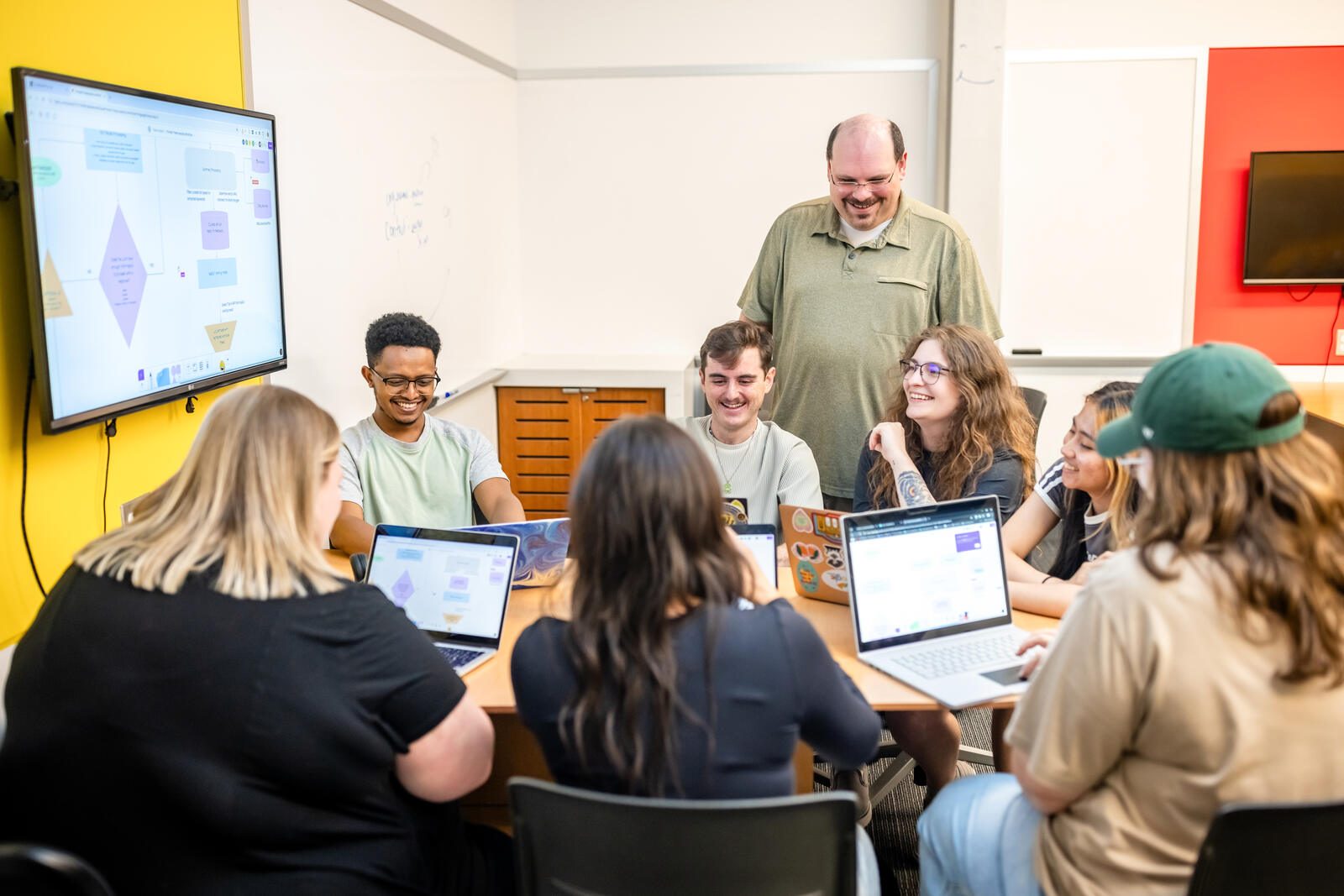
Dr. Daniel Pittman, C3 Lab co-director, with students
A statewide platform that makes Colorado’s environmental data available through plain-language conversation. It includes Bili, an AI assistant that answers sustainability questions with citations. Funded by the National Science Foundation (NSF).
A statewide platform that links K-12 schools, colleges, nonprofits, and industry so that STEM pathways are visible from classroom to career. Funded by the Colorado Statewide Internet Portal Authority.
The lab also builds platforms for MSU Denver itself: Roadrunner Connect, a campus event and engagement app built by students, and Peer Support Hub, which coordinates the Supplemental Instruction, Teaching Assistant, and Learning Assistant programs.
MSU Denver is an educational partner in AI-ALOE, the National AI Institute for Adult Learning and Online Education, a National Science Foundation institute led by the Georgia Institute of Technology (Georgia Tech). The institute studies how AI can help adults build skills for work, with a focus on advanced manufacturing and data science. See Partnerships for the Colorado industry side of this work.
Geinitz, S., Rajan, R., Peprah, K., Schmidt, K. C. S., Singh, S., & Jay, S. M. (2026). Generative AI as a tool for learning: Higher education student perceptions and performance across disciplines. In M. E. Auer, K. Ram B., & T. Tsiatsos (Eds.), Artificial intelligence in education (pp. 3–14). Springer. https://doi.org/10.1007/978-3-032-25387-3_1
Olson, E., & Ogbeide, G.-C. (2024, July 24–26). ChatGPT for hospitality and tourism education: To adopt or not to adopt [Conference presentation]. International Council on Hotel, Restaurant, and Institutional Education Global Conference, Montreal, Quebec, Canada.
Pittman, D., Williams, A., Haring, K., Salo, J., Newman, G., Kennedy, A., Newman, S., & Kalevela, S. (2025). Co-creating a regional sustainability hub: Conversational AI, community engagement, and local data for computing in place. In COMPASS ’25: Proceedings of the ACM SIGCAS/SIGCHI Conference on Computing and Sustainable Societies (pp. 746–751). Association for Computing Machinery.
Sell, C. R., & Rudnick, D. L. (2026, October 28–30). Who gets to decide? Embedding AI discourse into social studies methods as democratic practice [Conference presentation]. AAC&U Conference on AI and Higher Education, Atlanta, GA.
To add your AI-related scholarship, email [email protected].
MSU Denver surveys its students and employees about how they use AI. See State of AI at MSU Denver for the findings.
MSU Denver is also inviting faculty to study the University’s own use of AI: what it deploys, how people use it, and what changes as a result.
Email [email protected] to take part