
Request Information
Ready to find out what MSU Denver can do for you? We’ve got you covered.
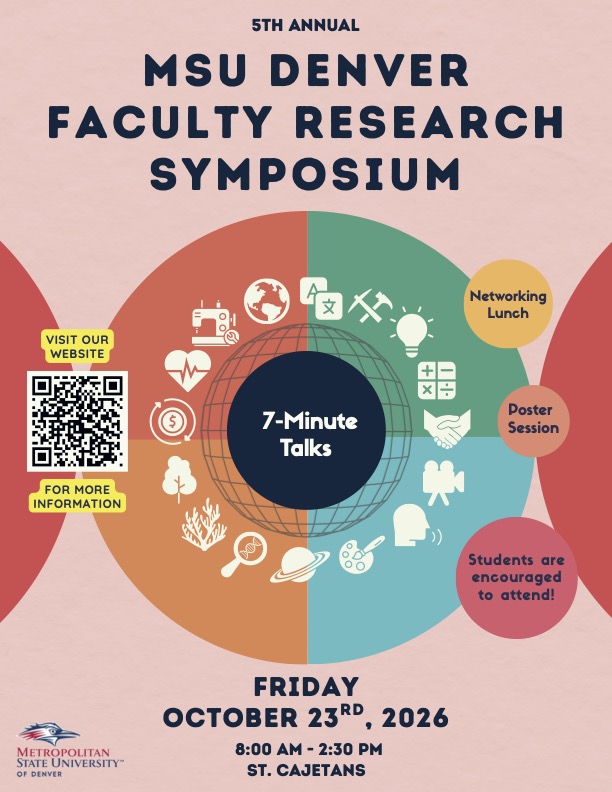
October 23, 2026
St. Cajetans
8:00-8:30am: Check-in and Light Breakfast
8:30-9:00am: Welcome and Faculty Keynote by Dr. Andrew Bonham, Professor and Dept Chair, Chemistry
9:10-10:10am: Session I
10:20-11:20am: Session II
11:20-11:30am: Remarks by Provost Makley
11:30-12:00pm: Poster Session and Break
12:00pm-1:00pm: Session III
1:00-2:30pm: Lunch (provided for registered attendees)
Sarah Schliemann, Earth and Atmospheric Sciences
Anne Yoncha, Art
David Farrell, Music
When public understanding of scientific phenomena is limited, art-science partnerships have been successful in building public interest and affinity. By collecting data on soil chemistry changes around bison carcasses at Genesee Park and using this data to create visual and sonic art, this project is a literal rumination on the impact of ruminant animals on soil health, visualizing invisible changes in chemistry at the microscopic level.
Matthew Sommer, Finance
This research explores how wealthy clients feel about their financial advisor using AI to help service their account.
Caitlin Fine, Elementary Education
Suree Towfighnia, Journalism and Media Production
Learn about a recent Colorado OER Collaborative Grant project between MSU Denver and Denver Public Schools: a video collection highlighting examples of translanguaging pedagogies in K-12 science classrooms. Translanguaging refers to the natural, dynamic languaging practices of multilingual individuals. Videos portray educators planning, enacting, and reflecting on translanguaging during lessons.
Kwabena Peprah, Marketing
The MSU Denver CBUS has initiated multiple AI committees and task forces, all with a common vision, and varying directives, of implementing AI technologies into the college. This AI learning module initiative was derived from one such committee/task force. Preliminary data, results, and descriptive statistics will be collected, evaluated, and presented during the 2026 MSU Denver Faculty Research Symposium.
Amy Kern, Industrial Design
This presentation presents a material experiential laboratory, and potential resulting forms, for investigating how materials, environmental conditions, and sensory interaction shape evolving relationships between people and designed objects. Through practice-based experimentation, it introduces temporal tolerance as a framework for designing perceptual, material, and experiential change over time.
Charlie Lunaris, Speech, Language and Hearing Sciences
The Bookhardt Family Speech-Language Clinic provides free evaluation and treatment services for people with communication disabilities. One of these services is the SPEAK OUT!® Therapy Program, developed by Parkinson Voice Project, which helps people with Parkinson’s and related disorders regain and retain their speech. Currently, we have 82 clients across Wyoming and Colorado being served in individual or group therapy. Preliminary results show that this therapy program is beneficial for retaining and regaining speech intelligibility for people with Parkinson’s disease.
Eric Olson, Hospitality
Despite their historical significance, LGBTQ+ bars have experienced decline in recent years. Drawing on queer theory, social capital theory, and servicescape frameworks, this aim of this study is to examine LGBTQ+ perceptions of gay bars in a hospitality service context.
Steve Geinitz, Computer Science
Today’s use of AI in education is one of pure automation, which often hinders an educator’s ability to genuinely connect with students and help them learn effectively. An alternative approach to is to *augment* the educator’s ability to connect with students, better understand their learning process, and encourage their success.
Marsha Montano, Social Work
This project examines how culturally responsive mentorship and belonging practices in higher education can support community-building among historically excluded professionals. Uplifting Voices of Color Through Community connects professionals to share resources and strengthen collaboration. The presentation explores implementation, participant feedback, and opportunities for sustainable support across institutional and community boundaries.
Andrew Gillespie, Physics
Enhanced hydrogen storage systems densify fuels using adsorbent materials. By synthesizing adsorbents from spent coffee grounds, we achieved a 28% increase in storage capacity over compressed gas alone, offering a cleaner, bio-based alternative to petroleum-derived materials currently on the market. Building on these results, these materials are now being loaded with heavy hydrogen (deuterium) for nuclear fusion experiments aimed at pioneering safer, cleaner energy production.
Bethany Dillen, Psychological Sciences
How do parents and professionals evaluate AI-generated parenting advice? This presentation shares findings from a multi-study research program examining trust, credibility, and perceptions of AI parenting guidance, along with emerging research on how parents’ own prompts may shape the advice AI provides.
David Merriam, Biology
I discuss two unusual marine contaminants, not typically found on human skin or other typical sources of contamination. I review sequencing results and what that identification means for future research at MSU Denver.
Chao Wei, Finance
This study examines how import competition affects U.S. community banks during the 2008-2010 financial crisis. Using cross-county variation in import exposure, we find that greater import competition improved bank profitability and credit quality by strengthening local business liquidity and reducing reliance on external financing, highlighting a stabilizing channel of trade globalization.
Jean-François Duclos, World Languages
This project documents the non-standard vocabulary—slang, rare words, and thousands of original neologisms—found throughout Louis-Ferdinand Céline’s novels. Using digital humanities methods, it builds a searchable online dictionary defining each term, tracing its construction, and cataloguing every occurrence across his published work.
Sylvia Brady, Earth and Atmospheric Sciences
Blind and low-vision travelers encounter distinct challenges when using ride-hailing services. Drawing on fifty semi-structured interviews, this presentation examines how reliability, safety, driver training, service-animal discrimination, and limited accountability shape transportation experiences and choices for blind and low-vision adults.
Charlie Butterworth, Biology
Preliminary results of a DNA microsatellite analysis of two Federally-listed cactus species (Pediocactus despainii and P. winkleri)from central Utah was undertaken in CUREs components in classes run by Dr. Butterworth (Laboratory Techniques and Genetics: Principles and Analysis).
Daniel Pittman, Computer Sciences
Ranjidha Rajan, Computer Sciences
Alyssa Williams
Undergraduate research is often an apprenticeship: one mentor, one student, few positions. The Community-Centered Computing Lab instead staffs fourteen undergraduates as the primary engineering team for externally funded software with real users. We present what that model requires, what it produces, and what it costs.
Marie Spence, Social Work
This case study uses a community-based research framework to explore the application of Trauma-Informed Design to the mental health practice setting. It highlights the importance of applying trauma-informed care principles to the service delivery environment and engaging community members in shaping the care they receive.
Logan Schuetz, Exercise and Sport Science
Brakelle Westphal, Exercise and Sport Science
Jay Martyn, Exercise and Sport Science
Lola Khokhryakova, Exercise and Sport Science
Lincoln Davie, Exercise and Sport Science
This study examines grit, passion, and work-life balance among sport employees. The study explores how these factors relate to employees’ experiences in the sport workplace and provides further insight into the challenges and resources associated with working in the sport industry.
Bridget Arend, Center for Teaching, Learning and Design
Becky Cottrell, Social Work
Kim Hosler, University of Denver
Virginia Pitts, University of Denver,
Natalia Umaña, University of Colorado Boulder
Over twenty years ago, Dee Fink developed the Taxonomy of Significant Learning to bring goals such as caring, connection, and lifelong learning into college course design. This project reviewed 141 studies to map how the framework has been used worldwide, what outcomes are reported, and future research directions.
Marin Abell, Art
We are not one and the same – positioned differently in terms of entitlement, opportunity, power and access to the conditions that define us. I explore my conflict-ridden community as a neo-materialism to illuminate what’s happening to us as well as explore how much agency we have towards the formation of our own subjecthood.
Deborah Horan, Elementary Education and Literacy
Our self-study examines the impact of La Casa en Mango Street (Cisneros, 1984) read by a multilingual preservice, elementary teacher during childhood and revisited during teacher preparation. Through Visual Verbal Journals (VVJs), Visual Learning Analysis (VLA, Whitmore et al, 2019) and Reader Response Theory (Rosenblatt, 1978) afforded a nuanced multimodal space for capturing complex identities across Cisneros’s chapter book and current Spanish-language children’s literature.
Thyago Mota, Computer Science
Liquid Organic Hydrogen Carrier (LOHC’s) are promising hydrogen carriers; however, the release of H₂, known as dehydrogenation, has high desorption enthalpies and the bulk heating causes production of unwanted by-products. This research focuses on using light for localized heat delivery with LED’s which can reduce the energy input by minimizing bulk heating, allow for scale-up, and lastly improve selectivity towards H₂ release over undesired by-products.
Lina Xu, Marketing
This teaching case introduces customer segmentation through Excel-based Recency–Frequency–Monetary (RFM) analysis in Principles of Marketing courses. Using real transactional data, students develop foundational analytics skills by cleaning data, constructing RFM measures, identifying customer segments, and translating insights into actionable marketing strategies without requiring advanced technical expertise.
Masako Nunn, World Languages
This study explores how intermediate Japanese learners engage with literary texts through appropriate learning supports and Bloom’s Taxonomy. Using qualitative data from eight students, the research examines motivation, autonomy, and higher-order thinking. Findings highlight how scaffolding and literature-based activities can promote analysis, creativity, intrinsic motivation, and effective Japanese language learning.
Jeffrey Ogle, Philosophy
Aristotle claims that the best life for human beings is also the most pleasant, while rejecting the life devoted to pleasure. My presentation explores this tension, arguing that pleasure belongs to a life of worthwhile activity pursued for its own sake; we go wrong when pleasure becomes the focus.
Richard Ashmore, Earth and Atmospheric Sciences
What changes when AI is designed into a course from the beginning rather than added later? This presentation explores AI-native learning environments, intentional human-AI roles, productive intellectual friction, and how educators can keep human judgment at the center of learning.
Elizabeth Medina, Biology
Phage Morrey was discovered and characterized by students at Front Range Community College Westminster campus through the SEA-PHAGES CURE program. Students isolated the phage from a soil sample and characterized its plaque and structure morphology as well as annotated the genome using various bioinformatic tools.
Bill Herman, Marketing
Jesse Helm and Carlos Jobe
Do open educational resources improve student outcomes? Analyzing 41,000 MSU Denver enrollments with course fixed effects, we find OER courses yield grades 0.22 points higher on a 4.0 scale and next-semester retention 3.8 percentage points higher. We discuss implications for OER investment at access institutions.
Christopher Meloche, Biology
The Denver Mountain Parks includes over 14,000 acres of property in 22 parks and 24 conservation areas. Despite existing since 1914 plant species lists for these parks do not exist for managers or visitors We are conducting surveys in which we identify plant species in these parks.
Tian Jiang, Sociology and Anthropology
Todd Laugen, History
Generative AI has undermined take-home assessment in online courses. This session presents Competency Verification Exams, a two-lane model pairing AI-permissive online coursework with proctored, in-person exams, now piloting in History Department General Studies courses. Learn the modality, staffing, and equity considerations for adapting it at your institution.