
Have Questions? We have answers.
Contact UsCHHS Alum Spotlight: Milwaukee Brewers’ Roger Caplinger on building the team behind the team


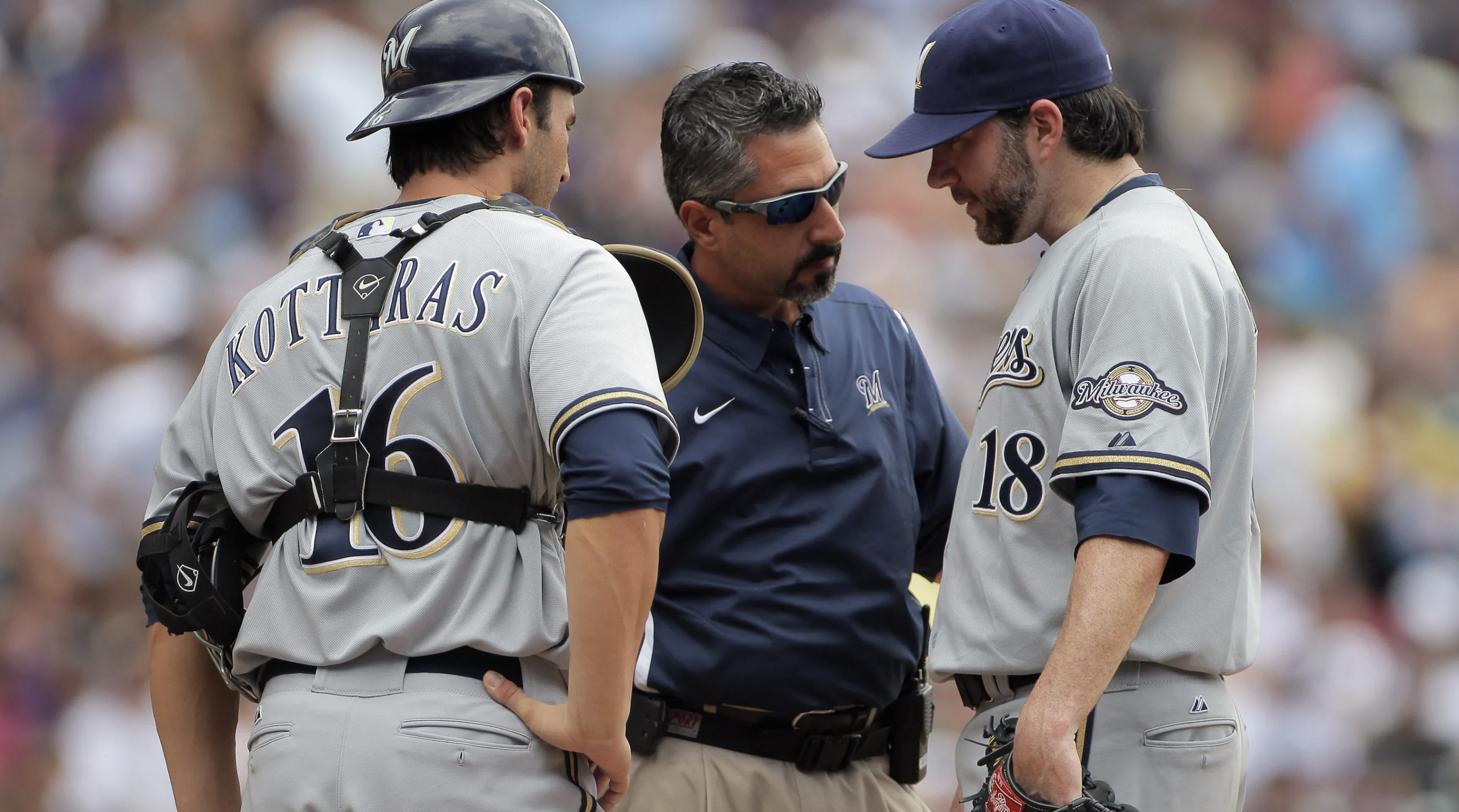
From left: Milwaukee Brewers catcher George Kottaras, athletic trainer and MSU Denver alum Roger Caplinger and pitcher Shaun Marcum confer during a game. All images courtesy Roger Caplinger.
For a guy who started his athletic-trainer career as an unpaid intern for a minor league team with an uncertain future, Roger Caplinger (’91) has done all right for himself.
In 33 years with the Milwaukee Brewers Baseball Club, Caplinger rose to the position of vice president of medical operations – but beyond that, he changed teams’ approach to caring for players, pioneering an integrated medical approach that is now the standard throughout Major League Baseball.
Along the way, also beat pancreatic cancer and contributed to research on the disease.
Not bad for a kid from Wheat Ridge
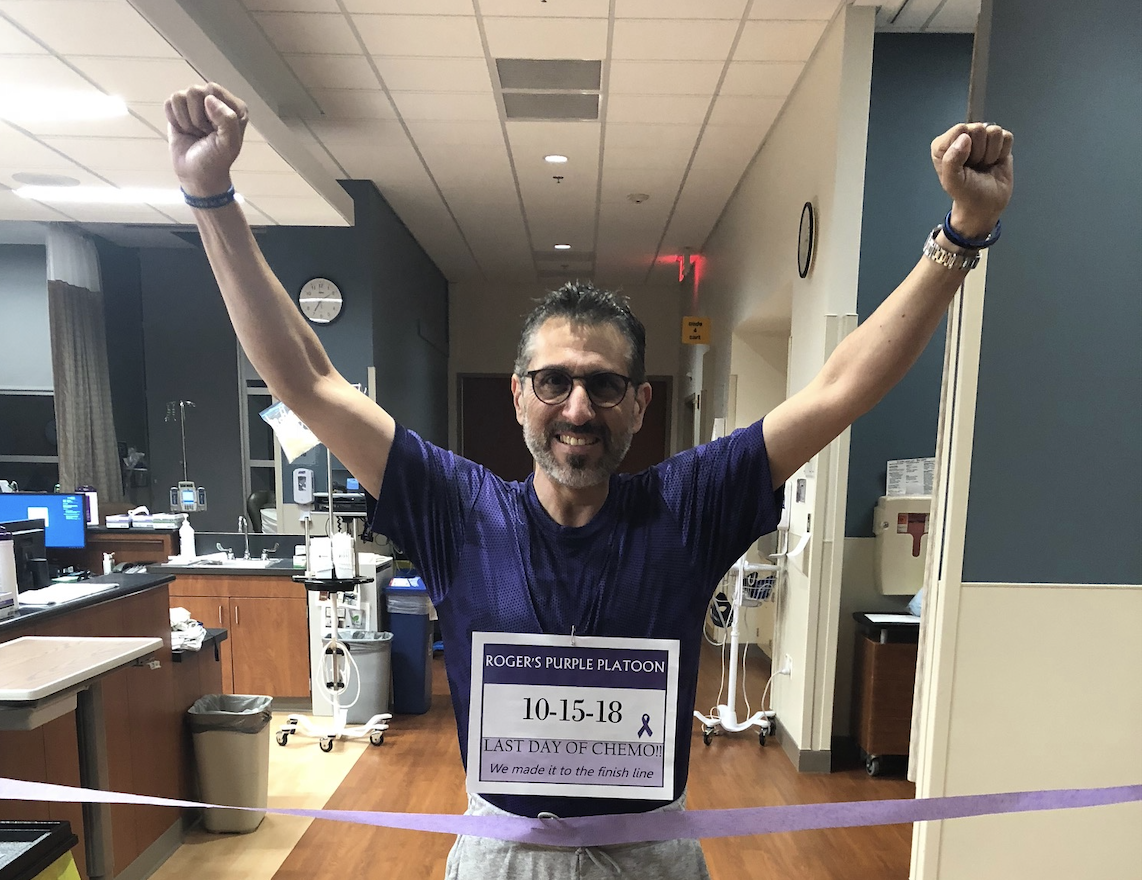
Caplinger's graduation from chemotherapy, Oct. 15 2018.
The road to the big leagues was hardly mapped out for Caplinger. He initially planned to become an orthopedic surgeon, but an uncle (who was an NFL referee) steered him toward the emerging athletic-training profession.
That led Caplinger to Metropolitan State University of Denver – then Metro State College – where he majored in physical education with an emphasis in athletic training, a program that later became the Department of Exercise and Sport Sciences.
What was then a small, close-knit training community became his home base, the place where Caplinger learned to collaborate with coaches, athletes and fellow trainers.
“Everybody at Metro State had a seat at the table,” Caplinger recalled. “It wasn’t, ‘It’s my way or the highway.’
It was, ‘How do we serve our athletes to the best of our ability with the resources that we have?’”
He also formed a friendship that led to an internship with the Denver Zephyrs. At the time, the Zephyrs served as the Brewers’ Triple A team, before the Colorado Rockies arrived in 1993 and chased the Zephyrs to New Orleans.
When his mother asked what the internship paid, Caplinger had little reassurance to her.
“It doesn’t pay anything, Mom,” he recalled saying at the time. “But I’ve got a gut feeling this is going to work out.”
It did. The leap-of-faith internship led to positions throughout Milwaukee’s minor-league system, although Caplinger temporarily stepped away to pursue a master’s degree in education administration at the University of Colorado. He was cautioned that if he left baseball, he might never work in the sport again, but once again Caplinger accepted the risk and chose education and landed back with the organization after diploma number two.
That interprofessional perspective helped him identify another opportunity: The Brewers needed someone to coordinate medical care throughout their minor-league system. Only a few organizations had such a position at the time, but after Caplinger helped establish the role, it now is a standard across all 30 Major League clubs. Following this win, he was promoted to the major-league staff as assistant athletic-trainiger in 1998 and became head athletic trainer in 2002.
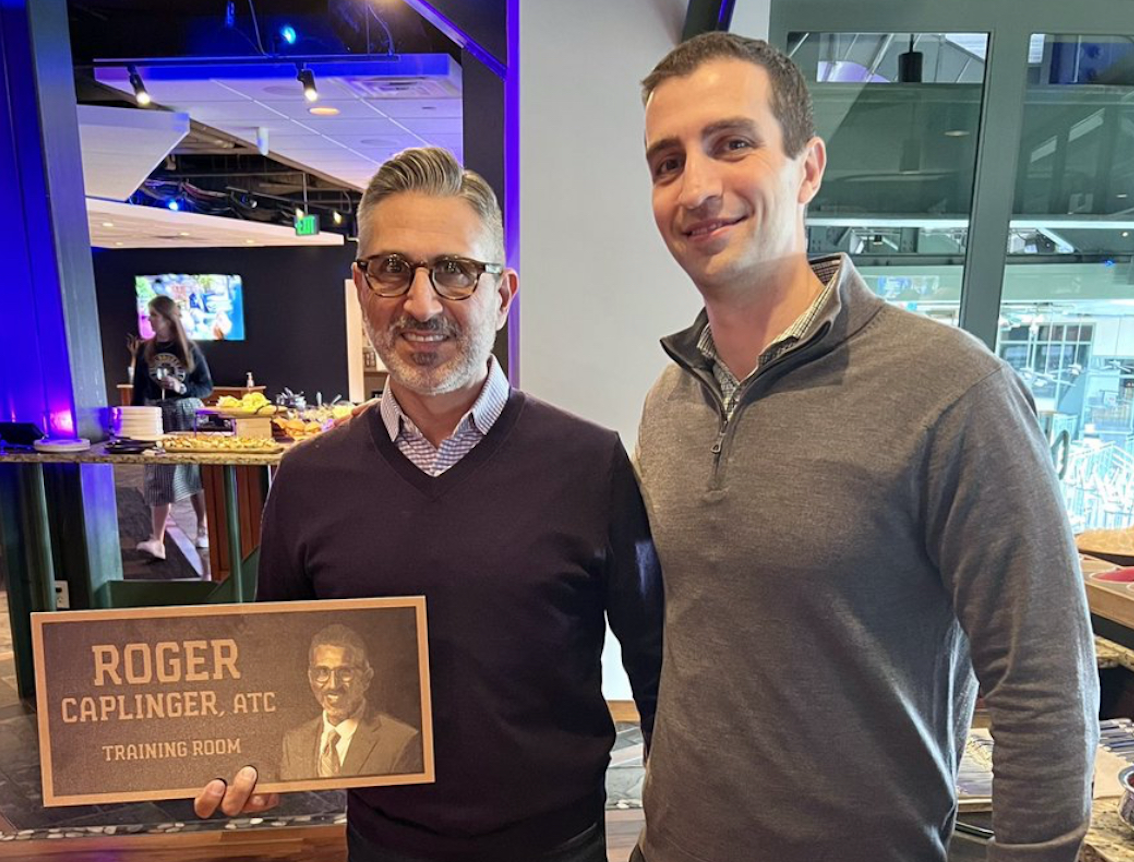
Dedication of the Milwaukee Brewers Roger Caplinger Athletic Training Room by Brewers' then-president of baseball operations, David Sterans at Caplinger's retirement ceremony, Oct. 2023
By 2011, after a decade as head athletic trainer, Caplinger was ready to leave behind the six months of near-daily travel – but not the ball club itself.
Instead, he proposed a position that did not exist: director of medical operations. In it, he imagined bringing athletic training, rehabilitation, sports science, psychology, strength and conditioning, workplace safety and employee health under one coordinated system.
It was a natural extension of the philosophy he had absorbed at MSU Denver: Everyone involved in caring for an athlete – or an organization – has a role to play.
His transition into medical operations expanded his impact across the organization, as Caplinger oversaw the medical care of players from the rookie leagues through the Milwaukee Brewers while fostering collaboration among physicians, athletic trainers, performance specialists, and administrators.
He also helped advance the Brewers’ annual medical symposium, which evolved into a model for similar initiatives throughout Major League Baseball. In addition, he chaired the MLB’s electronic-medical-records committee, helping shape the development and implementation of technology designed to enhance the continuity, efficiency, and quality of medical care across professional baseball.
Yet despite the wide-ranging impact of the work, his approach remained deeply personal.
“You can listen to somebody, but that’s different from hearing them,” he said. “If you listen and hear a player, they’re going to tell you exactly what’s wrong.”
That philosophy took on new urgency in December 2017, when Caplinger was diagnosed with Stage 1 pancreatic cancer. After his online research revealed the low average five-year survival rates for that diagnosis, he began putting his affairs in order. Then his baseball instincts took over as the longtime caregiver had to put his own trust in those around them.
“I’ve been part of a team for my whole adult life – so it made sense that I needed to surround myself with another team,” he said.
Caplinger turned to Dr. Douglas Evans and an interdisciplinary team at the Medical College of Wisconsin. Over 11 months of treatment, he underwent radiation, chemotherapy and the complex Whipple surgical procedure, which typically removes part of the pancreas, small intestine and gallbladder.
Throughout treatment, his medical background inspired him to contributing to pancreatic cancer research by participating in clinical trials. As part of one trial, Caplinger donated his tumor to the Massachusetts Institute of Technology for continued research.
Declared cancer-free after treatment (2018), Caplinger became an advocate for pancreatic cancer research and patient support. In June 2026, the Medical College of Wisconsin awarded him an honorary doctorate recognizing his work protecting health and advancing hope, and treatment, on and off the field.
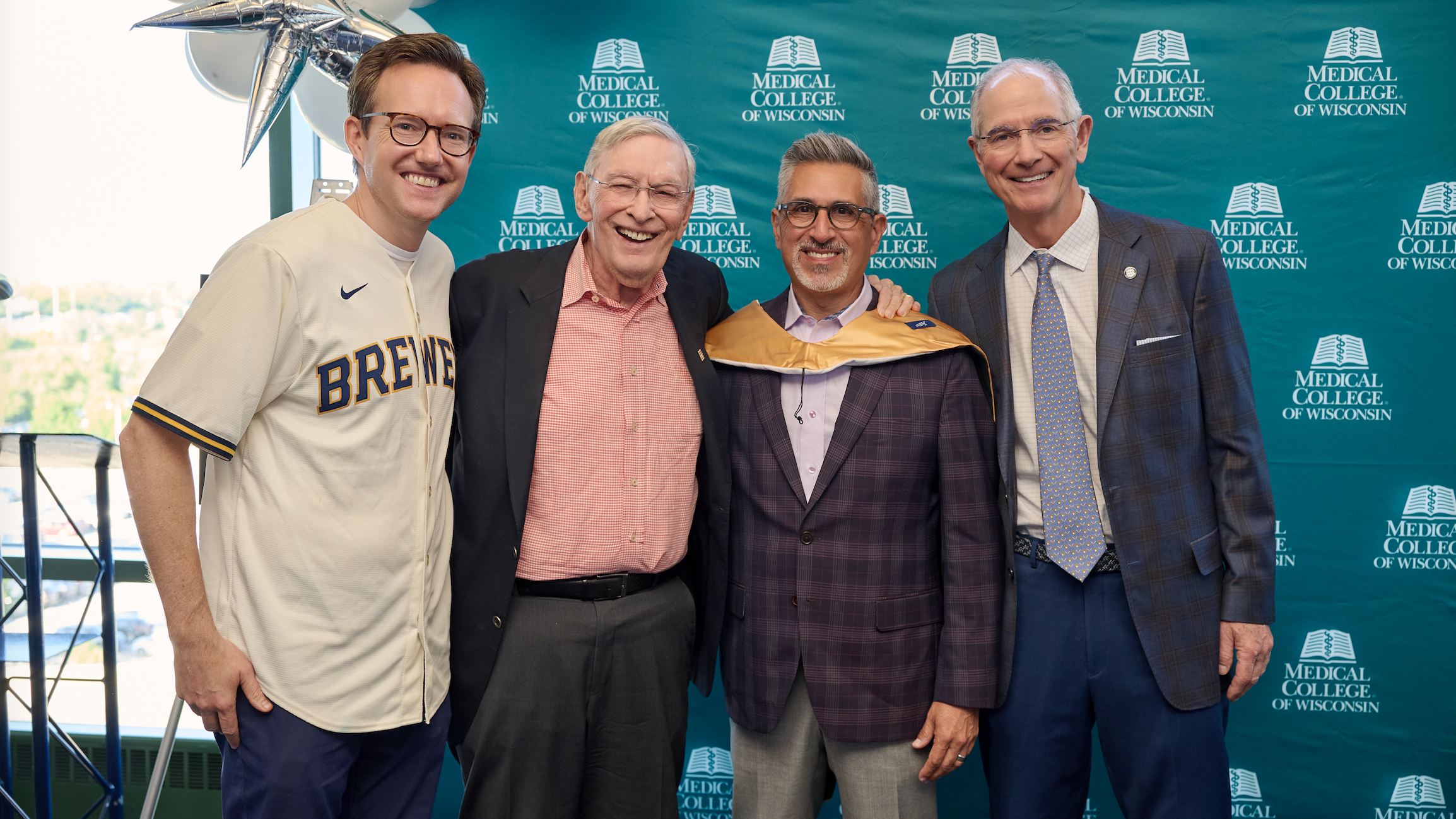
L-R: Dr. Bill Hall, Bob Uecker Chair for Pancreatic Cancer Research at the Medical College of Wisconsin; MLB Commissioner Emeritus Bud Selig; Caplinger; Dr. Doug Evans - at Caplinger's Medical College of Wisconsin honorary doctoral degree conferral, June 2026
Caplinger also returned to a rapidly changing game. Baseball’s expanding use of biometric information and artificial intelligence creates powerful new tools, but he cautions against confusing numbers with answers.
“Data drives a lot of stuff in baseball, and you have to understand how to merge that with medicine – and good medicine, not just some medicine,” he said. The medical professional’s responsibility, he added, is to interpret that information and turn it into a meaningful conversation with the player.
In 2023, Caplinger retired from full-time work after 33 seasons with the Brewers, but he continues consulting on health and wellness programs and mentoring athletic trainers. And while he may not be a regular fixture at American Family Field anymore, his reminders of his legacy and contributions remain, and will for a long time, as the clubhouse of the Milwaukee Brewers Athletic Training Room now bears his name in his honor – one of only three in Major League Baseball.
His title and responsibilities have evolved, but his work still reflects what he learned in an undersized training room back home in Colorado: Build the right team, listen to every voice and make certain everyone has a seat at the table.
“When someone throws you a curveball, you can either take it or you can crush it,” he said.
“So, build the right team – and crush it.”
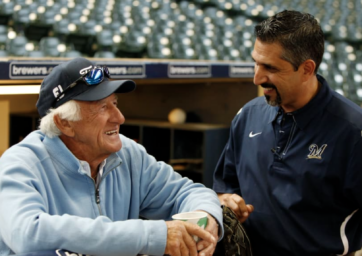
Brewers' longtime announcer, Bob Uecker (left), speaking to Roger Caplinger.
“HE’S OURS”: REMEMBERING BOB UECKER
Of the many people Roger Caplinger cared for during his Brewers career, few became closer to him the Major League catcher who became a legendary broadcaster, Bob Uecker.
Caplinger helped manage Uecker’s health for roughly 25 years, often arranging treatment around home games and road trips. Like Caplinger, Uecker had pancreatic issues, going on to make significant contributions to related research and treatment.
Caplinger remembers the man beyond the microphone – the loyal Milwaukeean who embraced anyone who entered his orbit. One story exemplifies this to Caplinger. Before a Milwaukee air show by the U.S. Navy’s Blue Angels, Uecker boarded a military refueling plane to surprise the flight squadron. Hidden near the refueling boom in a cap and sunglasses, he waited until the first jet approached.
“Blue Angel One,” Uecker announced over the radio. The pilot looked closer and replied, “Ueck?”
“It was chaos,” Caplinger recalled. The pilots could not believe Mr. Baseball was speaking to them from a tanker in the sky. Uecker later invited the group to the ballpark and into his booth where, Caplinger said, they emptied his famously well-stocked refrigerator.
Following Uecker’s death in 2025, his family publicly thanked Caplinger as both a vital part of his care and a dear friend.
“He’s ours,” Caplinger said of the Milwaukee icon. “He’s all ours.”