
Have Questions? We have answers.
Contact UsSocial Change Happens Together: Highlights from the First Social Change & Policy Conference
Environmental Justice and the Power of Collective Action in Social Work

November 5, 2026


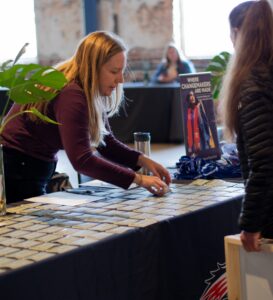
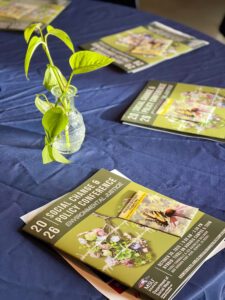 On October 30, 2026, the MSU Denver Department of Social Work brought students, practitioners, community organizers, educators, and advocates together for the Social Change & Policy Conference on Environmental Justice. The conference welcomed 155 registrants, with approximately 75 attending in person at the Tivoli Turnhalle with others participating virtually. Through presentations, hands-on activities, and discussion, attendees explored how environmental issues intersect with social justice and how social workers can help create a more equitable future.
The conference centered on one key message: Social change doesn’t happen because one person carries the weight of the world. It happens when communities connect, recognize their collective power, and take action to create a better future together.
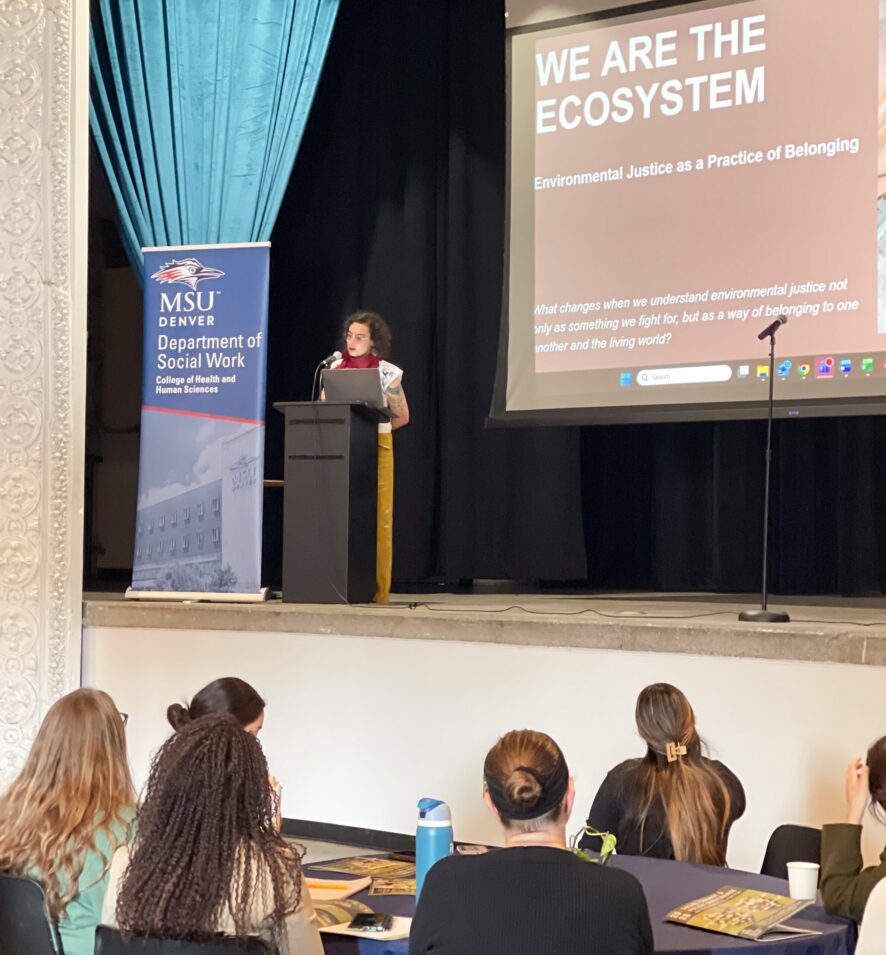
Keynote speaker Beatriz Oliva Soto addresses the audience from a podium beneath a slide reading “We Are the Ecosystem."
We Are the Ecosystem: Environmental Justice as a Practice of Belonging
Keynote speaker Beatriz Oliva Soto, Senior Director of Community Engagement at Conservation Colorado, invited attendees to reconsider their relationship with the natural world and one another. Through personal storytelling and reflection, Soto connected environmental justice to belonging, interconnectedness, and our responsibility to respond to the issues we care about.
Challenging the idea that the environment is separate from us, she urged attendees to consider a different understanding of environmental justice by asking, “What if environmental justice is not something we fight for, but a way of understanding how we belong?”

“Knowing how to survive somewhere is not the same as belonging.”
– Keynote Beatriz Oliva Soto
Soto explored how environmental injustice intersects with housing insecurity, inadequate infrastructure, language barriers, and economic disparities. She also made space for grief—not simply over what has been lost, but as an expression of love for the people, places, and natural world we want to protect. Her message encouraged attendees to imagine a future beyond despair and recognize that everyone has something to contribute.
Creating change does not mean carrying every problem alone; it means finding ways to respond alongside others.
Learning to Advocate, Organize, and Share Power
Breakout sessions offered practical examples of environmental justice advocacy and its connections to social work.
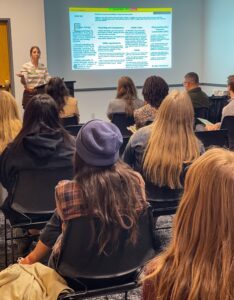
In “Thirst for Data: Water Use by Data Centers and Public Testimony Workshop,” Daniel Anderson, JD, Megan Kemp, MA, Earthjustice Colorado Policy Representative, and Tyanne Benallie, JD, explored the effects of data center development on water resources and community well-being. Benallie brought an important Diné perspective to conversations about Tribal water rights. Attendees also practiced public testimony, learning to combine personal stories, relevant information, and clear requests to influence decisionmakers. One attendee described the exercise as “empowering.”
Other sessions explored the human and community dimensions of environmental justice. “Grief, Regulation & Resistance: Sustaining Ourselves and Our Movements in a Changing Climate,” led by Amy Pickett-Williams, LCSW, and Devon Hukill, MA, addressed climate grief and ecological anxiety, emphasizing connection and collective care. “Designing the Conditions for Authentic Youth Climate Leadership: Lessons from Regenerative Education,” led by PhD candidate Erin Flynn, Mariah Rosensweig, Kelly Moses, and Amelia Fernández Rodríguez, highlighted how young people can move beyond symbolic participation and gain meaningful power to shape decisions.
Presenters also examined the relationship between environmental conditions and community well-being. In “Beyond Eco-Anxiety: Building Social Connectedness as Climate Resilience Practice in Social Work,” PhD candidate Rachel Forbes explored climate anxiety and community connectedness, while “Effective Grassroots Engagement with Air Quality Policy Decision Makers” highlighted how neighborhood monitoring, public participation, and community advocacy can advance cleaner air. Both sessions emphasized the importance of including affected communities in shaping solutions.
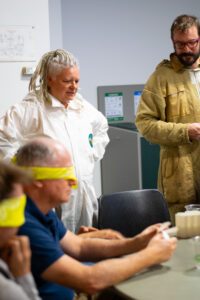
A particularly hands-on session, “BEE-ing in Touch: Confidence and Healing Through Environmental Justice,” was led by MSU Denver MSW student dAn Hlavinka and Professor of Social Work Dr. Kate Trujillo, alongside Devon Hukill and master beekeeper Shava Li Crocetta. Through beekeeping, gardening, and tactile art, participants explored confidence, healing, and accessibility, demonstrating how environmental engagement can support inclusion and well-being.
Two additional sessions looked toward the future of social work leadership and education. “Building Municipal Partnerships for Youth Climate Leadership: Preliminary Lessons from a Multi-City Climate Initiative” explored how young people can lead climate projects with support from community partners, while “Development and Implementation of an Ecological Justice Advanced Practice Curriculum for Master of Social Work Students” examined ways to integrate ecological justice into social work education. Together, the sessions reinforced that environmental justice is central to understanding human well-being and systems of inequality.
Arts, Awareness, Action: Bringing People Together
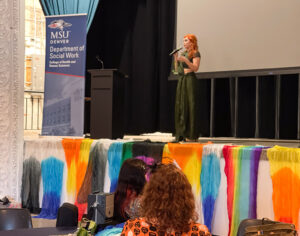 The conference concluded with “Arts – Awareness – Action: Making Moves Towards Social Change,” led by Harmony Cummings, Debora Montoya, Dawn Diaz, Juan Sebastian, Nicole Shea Niebler, and Morgan Brown. Through Indigenous wisdom, community storytelling, poetry, music, movement, and reflection, the speakers demonstrated how creative approaches can deepen awareness and bring people together. They connected environmental justice to the histories and policies shaping communities while emphasizing the importance of lived experience and neighborhood leadership.
The session also highlighted the importance of caring for ourselves and one another to sustain social change. As Harmony Cummings reminded attendees, “We cannot organize or make any progress if we are not grounded in our nervous systems.”
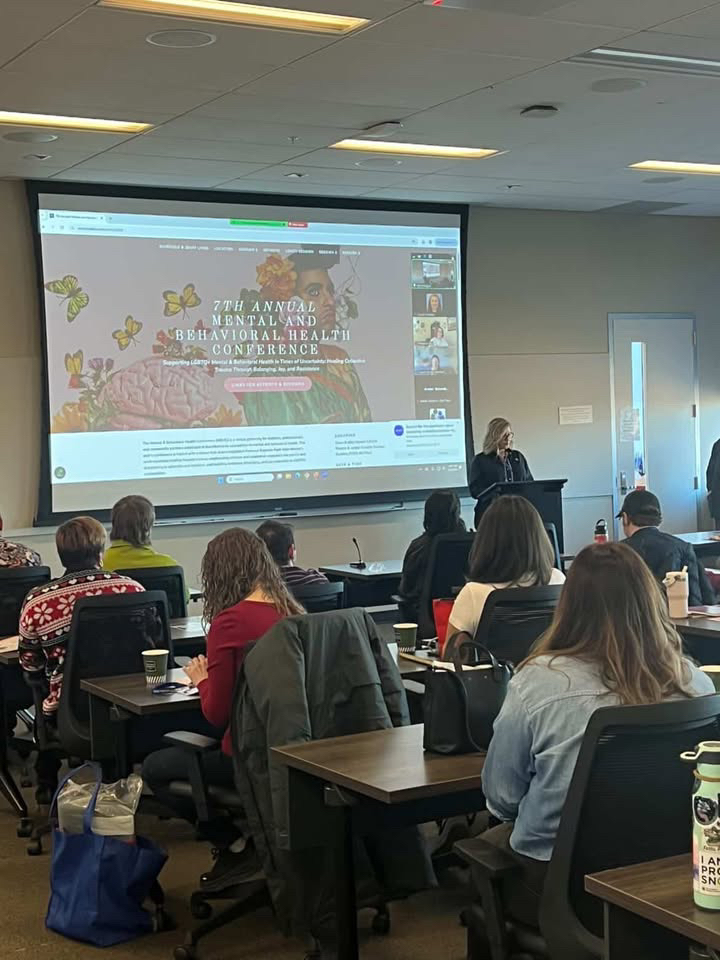
Samantha Montague (she/they), Director of Social Work Student Services, Operations & Finance, welcomes a full room of attendees to the 7th Annual Mental & Behavioral Health Conference.
Gratitude and Looking Forward
The Department of Social Work extends deep gratitude to our partners who made this vital gathering possible:
- MSU Denver’s Office of Student Affairs, Student Engagement and Well-being – our essential on-campus partner
- Mile High Behavioral Healthcare – Mental Health Champion Sponsor
- Chroma Wellness Center – Access Sponsor
To the nearly 200 participants who joined us—whether in the Jordan Student Success Building or from screens across the country—thank you for showing up. Thank you for creating community. Thank you for reminding us that in times of uncertainty, we find our strength in each other.
The conversations started on February 6th continue, the community we built that day endures, and the work of healing collective trauma through belonging, joy, and resistance carries on.
__________________________
For more information about future conferences and events, visit the MSU Denver Department of Social Work website and events page, or follow us on social media.
References
GLAAD Accountability Project. (2025). Trump accountability project. GLAAD. https://www.glaad.org/trump
Movement Advancement Project. (2025). LGBTQ policy spotlight: Executive actions. https://www.lgbtmap.org/
National Center for Transgender Equality. (2024). 2024 U.S. transgender survey. https://transequality.org/
Office of Management and Budget. (2025). Memorandum on temporary pause of financial assistance. Executive Office of the President.
Pew Research Center. (2025). LGBTQ adults’ views on Trump administration policies. https://www.pewresearch.org/
The Trevor Project. (2024). 2024 national survey on LGBTQ youth mental health. https://www.thetrevorproject.org/
Trans Legislation Tracker. (2026). 2026 anti-trans bills. https://translegislation.com/
White House. (2025). Executive order 14168: Defending women from gender ideology extremism and restoring biological truth to the federal government. https://www.whitehouse.gov/